Research follow-up
Check net use through unannounced home visits
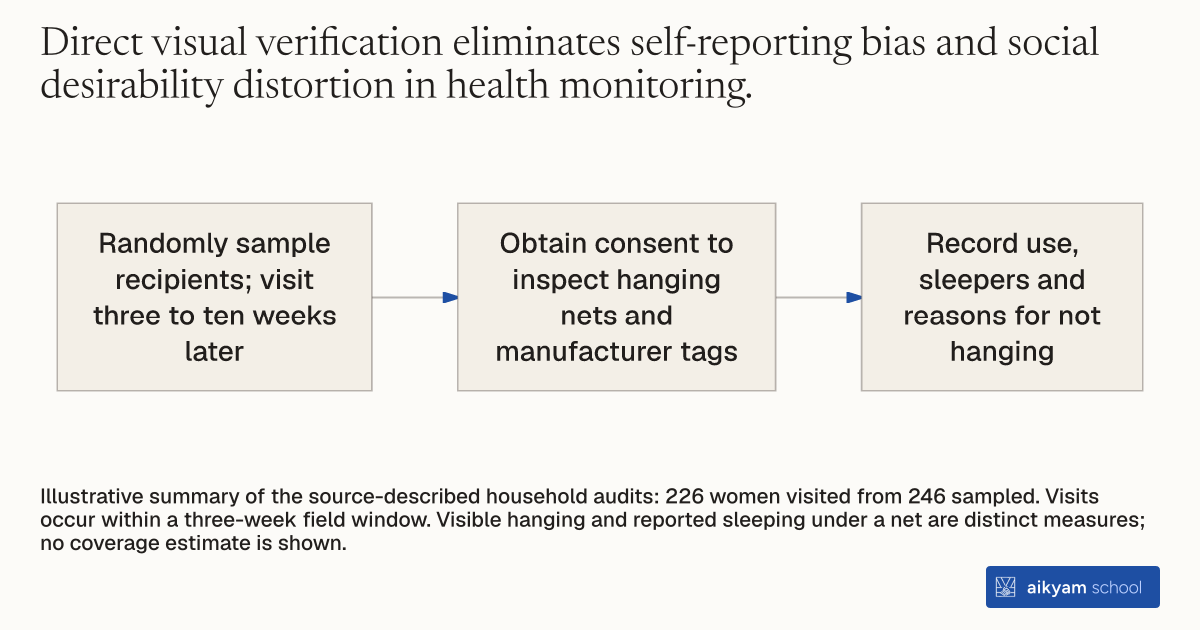
- Randomly sample recipients; visit three to ten weeks later
- Obtain consent to inspect hanging nets and manufacturer tags
- Record use, sleepers and reasons for not hanging
Illustrative summary of the source-described household audits: 226 women visited from 246 sampled. Visits occur within a three-week field window. Visible hanging and reported sleeping under a net are distinct measures; no coverage estimate is shown.
See source →How
When to use
Self-reported health behaviors often suffer from social desirability bias and overreporting. Conducting unannounced physical audits directly in recipients' homes allows evaluators to verify actual product adoption and usage. Public health evaluators use this technique to measure true effective coverage across different pricing schemes.
Verify real-time product usage by sending enumerators to perform unannounced visual inspections inside recipient households weeks after distribution.
- Surveyors receive list coordinates for a random sample of program beneficiaries without notifying participants in advance.
- Enumerators visit homes three to ten weeks after clinic distribution during a concentrated three-week window to ensure identical seasonal conditions.
- Field agents ask consent to enter sleeping areas and visually check if the bed net is removed from packaging and hanging from the ceiling.
- Surveyors inspect manufacturer tags on hanging bed nets to confirm their specific program origin and rule out existing non-program nets.
- Agents log whether household occupants sleep under the net and record qualitative reasons for non-hanging status if unmounted.
Why it works
Checking physical installation and unique product tags confirms genuine adoption rather than resale or storage.
Example
In western Kenya, field staff conducted unannounced home visits to 226 pregnant women who acquired bed nets at varying prices. Evaluators confirmed 57 percent of nets were visibly hanging, compared to 62 percent self-reported usage, proving effective coverage dropped from 65 percent under free distribution to 15 percent at 40 shillings.
About the study
Participants
226 pregnant women visited at home out of 246 sampled across western Kenya.
Study Design
Unannounced household follow-up inspections conducted 3 to 10 weeks after clinic visits during a 3-week standardized field window.
Results
Visual audits revealed a 57 percent hanging rate overall, while effective coverage dropped from 65 percent in the free group to 15 percent in the 40 Ksh group.