Research pricing sequence
Randomize discounts only after purchase commitment
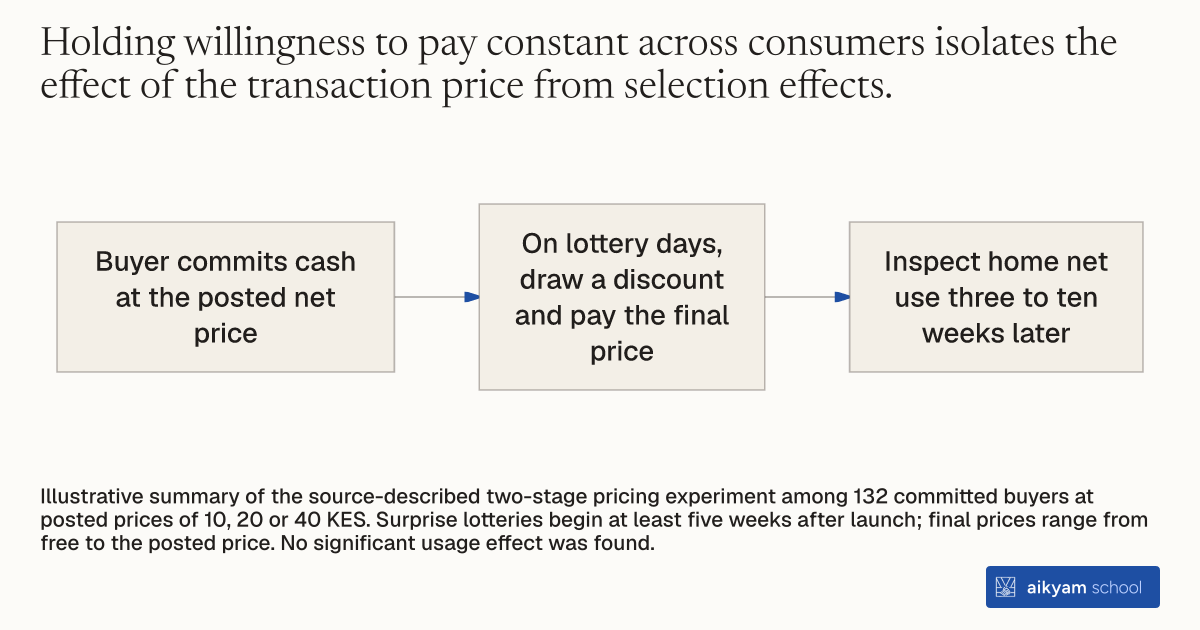
- Buyer commits cash at the posted net price
- On lottery days, draw a discount and pay the final price
- Inspect home net use three to ten weeks later
Illustrative summary of the source-described two-stage pricing experiment among 132 committed buyers at posted prices of 10, 20 or 40 KES. Surprise lotteries begin at least five weeks after launch; final prices range from free to the posted price. No significant usage effect was found.
See source →How
When to use
Researchers testing whether paying higher prices motivates recipients to use a health product face confounding selection bias. Offering a surprise discount after a customer commits to buy separates willingness to pay from the actual price paid. This methodology allows evaluators to isolate psychological sunk cost effects among consumers in field settings.
Test for psychological sunk cost effects on product usage by randomizing final transaction prices after consumers commit to purchasing at a posted price.
- Clinic health workers post a set subsidized price for bed nets in health center waiting areas.
- Expectant mothers decide whether to purchase a net at the posted price and present cash at the counter.
- Enumerators conduct surprise discount lotteries on unannounced days at least five weeks after program launch.
- Participating buyers pick an envelope from a basket containing vouchers for free nets or reduced transaction prices.
- Staff collect the final randomized transaction price and hand over the bed net to the buyer.
- Field agents perform unannounced home visits three to ten weeks later to observe whether recipients hang and use their nets.
Why it works
Comparing subsequent usage across price levels reveals whether paying a higher price directly induces psychological sunk cost behavior.
Example
In rural Kenyan prenatal clinics selling bed nets for 10, 20, or 40 Kenyan shillings, enumerators gave surprise lottery discounts to committed buyers. Transaction prices ranged from free to the posted price, but subsequent usage rates at home showed no significant difference based on the actual price paid.
About the study
Participants
132 pregnant women who committed to purchasing bed nets at positive prices across health clinics in western Kenya.
Study Design
Two-stage pricing randomized trial where committed buyers drew lotteries for surprise discounts, followed by unannounced household inspection visits 3 to 10 weeks later.
Results
Final transaction price had no statistically significant effect on net usage (point estimate -0.003, 95% CI -0.0158 to 0.0098), ruling out sunk cost effects greater than 7 percentage points per 10 Kenyan shillings.