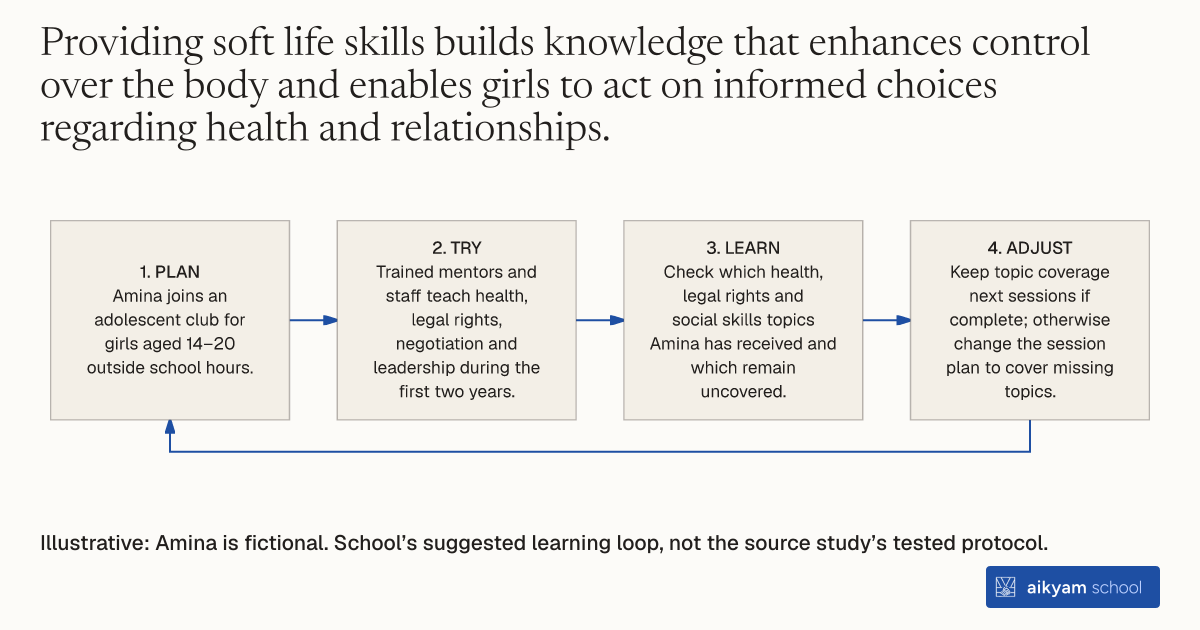
Try, learn and adjust
Check coverage of life skills and rights topics
- Plan: Amina joins an adolescent club for girls aged 14–20 outside school hours.
- Try: Trained mentors and staff teach health, legal rights, negotiation and leadership during the first two years.
- Learn: Check which health, legal rights and social skills topics Amina has received and which remain uncovered.
- Adjust: Keep topic coverage next sessions if complete; otherwise change the session plan to cover missing topics.
Illustrative: Amina is fictional. School’s suggested learning loop, not the source study’s tested protocol.
See source →School’s suggested, untested learning loop. Observe session coverage. This suggested loop is not clinical guidance or evidence of separate training effects.
How
When to use
Adolescent girls in developing countries often lack accurate information on sexual and reproductive health, legal rights, and interpersonal negotiation. This lack of knowledge combines with early childbearing and gender-based violence to limit their autonomy and force dependency on men. Deliver structured life skills education in community youth clubs to build knowledge that enables girls to make informed choices about reproduction, health, and social relationships.
Deliver interactive life skills, health, and legal rights training modules to adolescent girls through trained community mentors and professional staff.
- Mentors and BRAC professional staff lead regular life skills training sessions in adolescent development clubs during the first two years of operation.
- Instructors deliver modules on sexual and reproductive health, covering menstruation, pregnancy, sexually transmitted infections, HIV/AIDS awareness, and family planning.
- Mentors teach protective and legal awareness sessions covering rape, bride price, child marriage, and violence against women.
- Trainers deliver enabling social modules covering management skills, negotiation, conflict resolution, and leadership.
- Program staff provide course access to eligible adolescent girls aged 14 to 20 outside of regular school hours.
Why it works
Delivering these sensitive topics through near-peer mentors in a protected safe space ensures girls feel comfortable learning and asking questions without fear of judgment from teachers.
Example
BRAC delivered life skills training to 85% of adolescent club participants across 100 treated communities in Uganda over two years. By endline four years post-intervention, the training contributed to a 34% drop in teen pregnancy, a 62% reduction in early marriage/cohabitation, and a 31% reduction in girls reporting sex against their will.
About the study
Participants
4,888 adolescent girls tracked at midline and 3,522 at endline across 150 communities in Kampala, Mukono, Iganga, and Jinja, Uganda, with average baseline age of 16.3 years.
Study Design
Cluster randomized control trial across 150 communities (100 treatment, 50 control) stratified by 10 branch offices, evaluating outcomes at baseline, midline (2 years), and endline (4 years) using OLS ANCOVA and Lee bounds.
Results
Four years post-intervention, early pregnancy fell by 3.8 percentage points (34%), early marriage/cohabitation dropped by 8 percentage points (62%), reporting sex against will decreased by 5.3 percentage points (31%), and condom usage among sexually active girls increased by 13 percentage points at midline.