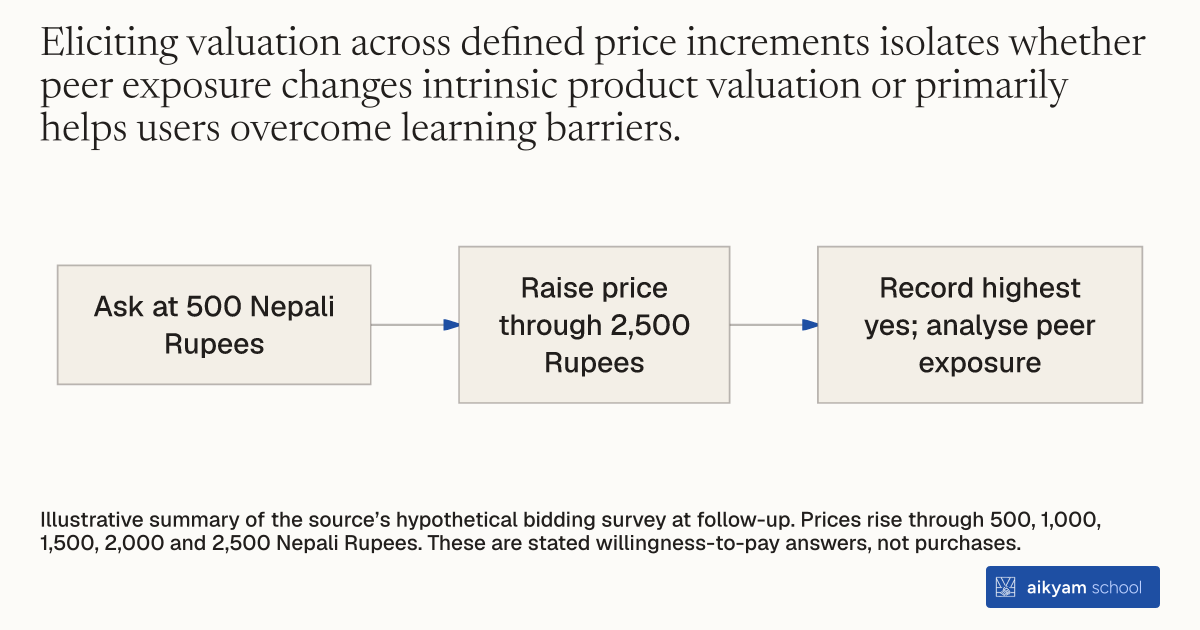
Research procedure
Ask hypothetical willingness to pay
- Ask at 500 Nepali Rupees
- Raise price through 2,500 Rupees
- Record highest yes; analyse peer exposure
Illustrative summary of the source’s hypothetical bidding survey at follow-up. Prices rise through 500, 1,000, 1,500, 2,000 and 2,500 Nepali Rupees. These are stated willingness-to-pay answers, not purchases.
See source →How
When to use
Organisations need to estimate how much target users value a novel health technology after gaining product experience. Actual market pricing transactions can be unfeasible when products are unavailable for commercial sale in local markets. Hypothetical price bidding questions gauge individual valuation across a structured price range.
Measure user product valuation by presenting respondents with a series of incremental hypothetical price thresholds.
- Schedule a follow-up survey session with participants who previously used or observed the health technology.
- Present each respondent individually with a hypothetical price point X for the product, starting at 500 Nepali Rupees.
- Ask the respondent if she would be willing to pay the stated price X to acquire the product.
- Increment the hypothetical price point sequentially through 1000, 1500, 2000, and up to 2500 Nepali Rupees.
- Record the highest price threshold at which the respondent answers affirmatively.
- Regress willingness-to-pay values on social network exposure to test whether peer ownership alters underlying product valuation.
Why it works
Holding usage ability constant allows researchers to confirm that peer effects operate through skill learning rather than increased willingness to pay.
Example
At a 15-month follow-up survey in Chitwan, Nepal, enumerators asked 67 adolescent girls who had used menstrual cups if they would pay prices from 500 to 2500 Nepali Rupees. Mean willingness to pay was 1380 Rupees (\$18 USD), and one additional peer with a cup increased willingness to pay by an statistically insignificant 188.39 Rupees.
About the study
Participants
67 adolescent female cup users (aged 14 on average) across four schools in Chitwan District, Nepal.
Study Design
Hypothetical willingness-to-pay bidding survey administered at 15-month follow-up, regressing valuation on number of peer treatment friends.
Results
Mean willingness to pay was 1380 Nepali Rupees (~\$18 USD); each additional treatment friend increased willingness to pay by an insignificant 188.39 Rupees (~12% of the mean).