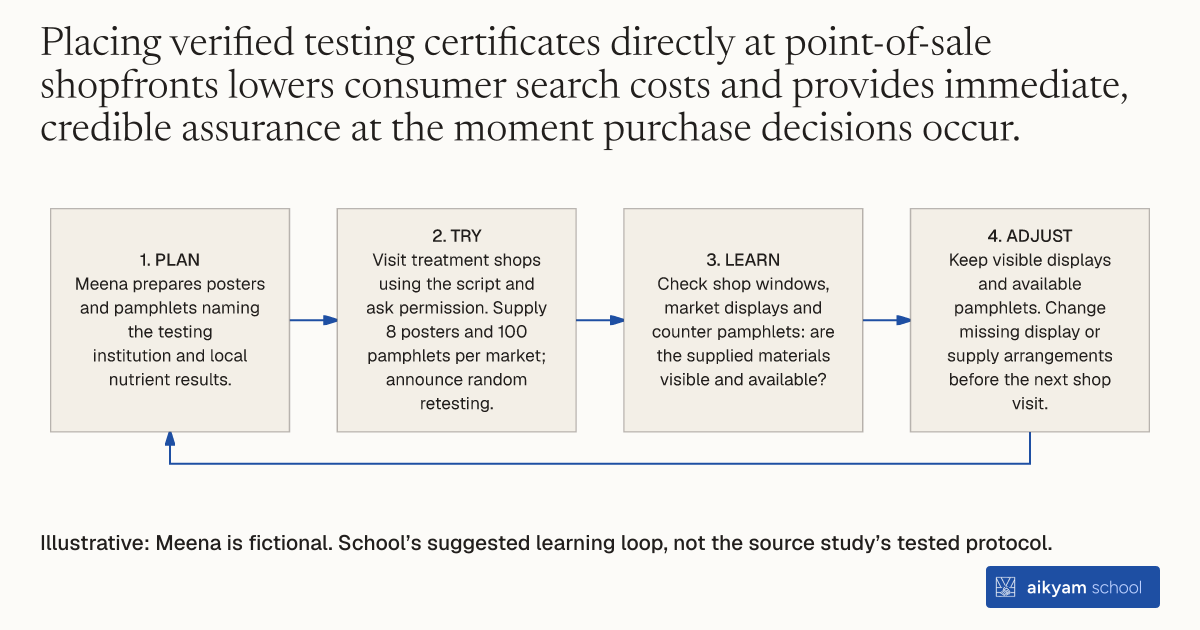
Try, learn and adjust
Check verified quality displays reach shops
- Plan: Meena prepares posters and pamphlets naming the testing institution and local nutrient results.
- Try: Visit treatment shops using the script and ask permission. Supply 8 posters and 100 pamphlets per market; announce random retesting.
- Learn: Check shop windows, market displays and counter pamphlets: are the supplied materials visible and available?
- Adjust: Keep visible displays and available pamphlets. Change missing display or supply arrangements before the next shop visit.
Illustrative: Meena is fictional. School’s suggested learning loop, not the source study’s tested protocol.
See source →School’s suggested learning loop checks display and material availability, separately from the tested market information campaign.
How
When to use
Smallholder farmers hesitate to purchase agricultural inputs at retail shops due to unobservable nutrient quality and fear of adulteration. Retail input merchants lack affordable ways to signal verified product quality directly to customers at the point of sale. Program implementers use this method to display certified test results directly in retail store windows and counters.
Distribute standardized quality verification posters and stacks of customer pamphlets to retail input shops using an official institutional script.
- Obtain verified laboratory chemical test results for input samples collected across target market clusters.
- Design colorful posters and informative pamphlets clearly displaying the testing institution name and active nutrient verification results.
- Train field officers to visit every retail input shop in designated treatment markets using a standardized verbal script.
- Inform shop managers of local test findings and request permission to display a poster in the shop window.
- Provide 8 posters and 100 pamphlets per market, hanging posters prominently in store windows and central market locations.
- Supply stacks of pamphlets to shop counters for retailers to distribute to customers during transactions.
- Inform merchants that follow-up random testing will occur to maintain compliance and prevent strategic merchant behavior.
Example
Field teams visited agro-dealers across treatment markets in Morogoro Region, Tanzania, placing shopfront posters and leaving 100 pamphlets per market confirming that laboratory tests showed local urea contained the required 46% nitrogen. No agro-dealers refused the posters or pamphlets, and treated dealers showed a 70% increase in willingness-to-pay for official university quality certification.
About the study
Participants
N = 232 agro-dealers across 89 markets in Morogoro Region, Tanzania.
Study Design
Cluster-randomized controlled trial with market-level baseline and endline enterprise surveys and contingent valuation elicitation.
Results
Treated agro-dealers increased willingness-to-pay for university quality certification by 35,349 TZS (a 70% increase over control mean of 47,950 TZS, p = 0.20), while market-level urea quantity sold increased by almost 5% (posterior probability > 0 is 90.8%).