Research procedure
Recruit a village voter focus group
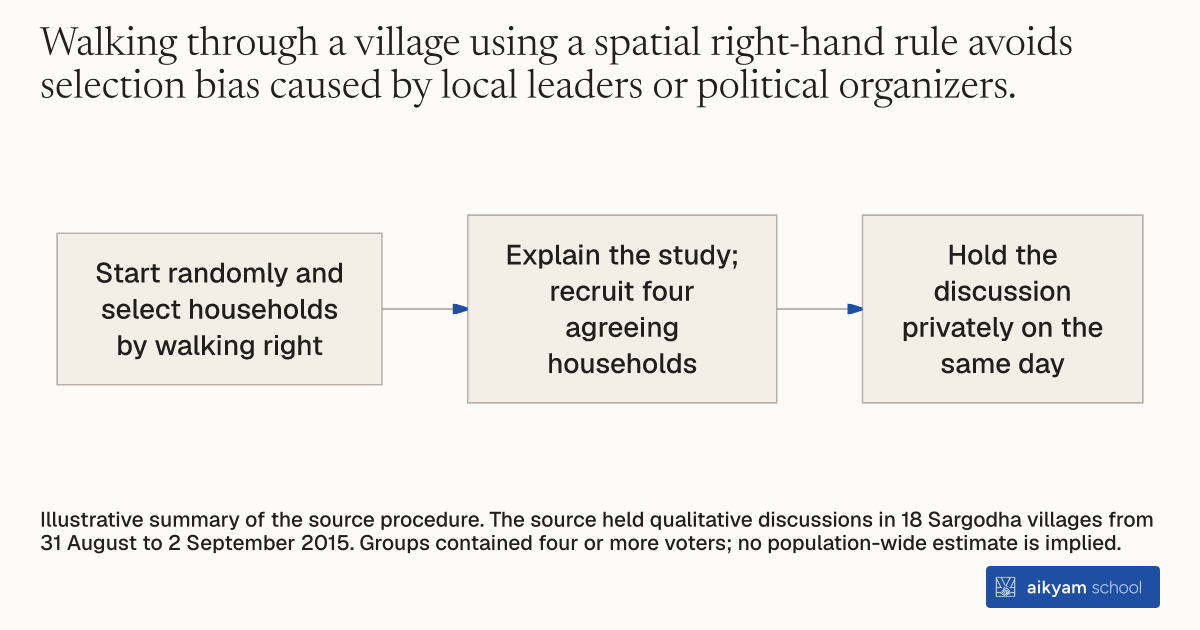
- Start randomly and select households by walking right
- Explain the study; recruit four agreeing households
- Hold the discussion privately on the same day
Illustrative summary of the source procedure. The source held qualitative discussions in 18 Sargodha villages from 31 August to 2 September 2015. Groups contained four or more voters; no population-wide estimate is implied.
See source →How
When to use
Researchers need to gather qualitative evidence on voter preferences and political expectations before an election. Unbiased field recruitment prevents focus group discussions from being skewed by local political gatekeepers. This method identifies representative community participants across rural villages without relying on partisan selection.
Select households systematically across villages using a right-hand walk rule to conduct voter focus group discussions.
- Field enumerators choose a random starting point in each target village.
- Field enumerators walk through the village employing a right-hand rule to select households.
- Field enumerators introduce themselves as researchers at each house and explain the intention to speak in a group setting about the upcoming election.
- Field enumerators stop recruitment once respondents from four separate households agree to participate.
- Field enumerators conduct the focus group discussion on the same day in a private space such as a sitting room where onlookers will not interrupt.
Why it works
Holding the session on the same day in a private sitting room allows open discussions without interruption from onlookers.
Example
Researchers conducted focus group discussions across 18 randomly selected villages in Sargodha district from 31 August to 2 September 2015, finding that nearly three-fourths of focus groups considered candidate connections to higher-tier politicians extremely important.
About the study
Participants
Respondents from four households per group across 18 randomly selected rural villages in Sargodha district, Punjab province, Pakistan.
Study Design
Qualitative field focus group study employing a random village starting point and a right-hand household recruitment rule.
Results
Nearly 75 percent of focus groups declared a candidate's connection with higher-tier ruling party politicians to be an extremely important reason to support a local candidate, while approximately 50 percent of respondents were undecided.