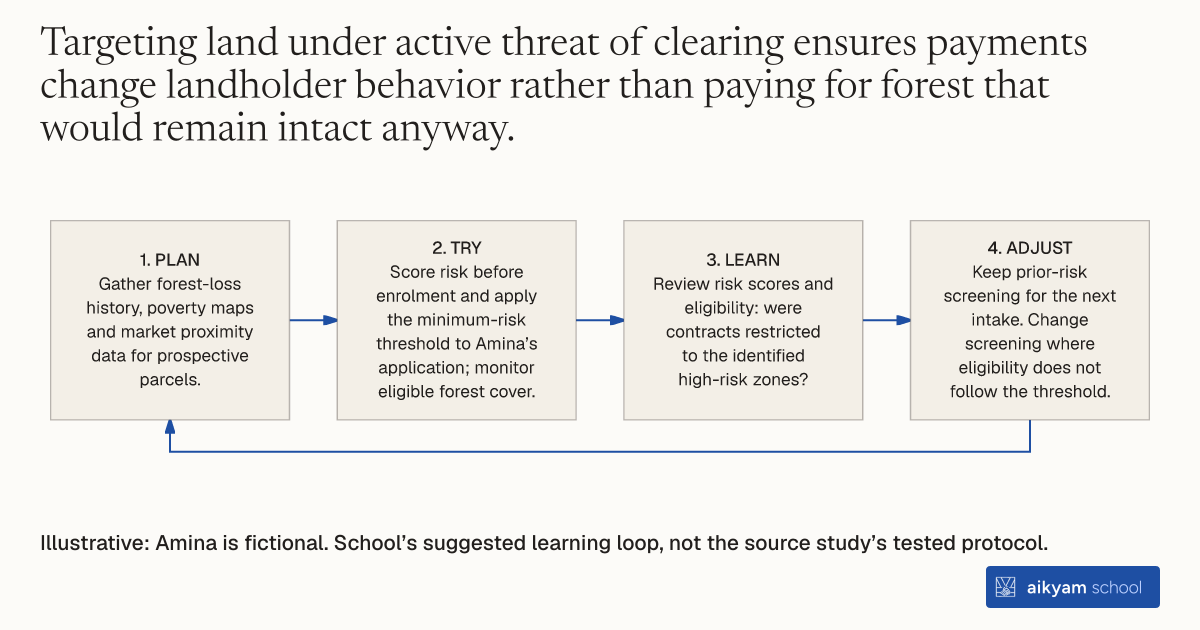
Try, learn and adjust
Check conservation eligibility uses prior risk data
- Plan: Gather forest-loss history, poverty maps and market proximity data for prospective parcels.
- Try: Score risk before enrolment and apply the minimum-risk threshold to Amina’s application; monitor eligible forest cover.
- Learn: Review risk scores and eligibility: were contracts restricted to the identified high-risk zones?
- Adjust: Keep prior-risk screening for the next intake. Change screening where eligibility does not follow the threshold.
Illustrative: Amina is fictional. School’s suggested learning loop, not the source study’s tested protocol.
See source →School’s suggested, untested loop. Observe risk data, eligibility and forest-cover changes; the source describes quasi-experimental evidence, not a new randomised test.
How
When to use
Standard conservation programs allocate funds to low-risk areas where forest clearing is unlikely to occur. Allocating payments to remote parcels creates zero additional conservation impact while consuming limited budgets. Targeting payments to high-risk areas close to markets solves ineffective funding allocation for program managers.
Target conservation payments to land parcels facing high ongoing deforestation threats based on historical loss and geographic indicators.
- Gather historical forest loss data, poverty maps, and market proximity indicators for target regions.
- Calculate spatial deforestation risk scores for all prospective land parcels prior to contract enrolment.
- Establish minimum risk score threshold criteria to screen incoming payment applications.
- Restrict conservation contract eligibility to land parcels located within high-risk geographic zones.
- Monitor forest cover changes across targeted high-risk parcels throughout the contract period.
Why it works
This focuses limited financial resources where environmental risk is highest.
Example
Evaluations in Mexico found that targeting PES to places prone to deforestation, such as areas closer to markets, produced greater conservation impacts than non-targeted schemes in Costa Rica.
About the study
Participants
Human landholders participating in national PES programs in Mexico and Costa Rica.
Study Design
Quasi-experimental studies analyzing geographic indicators, poverty maps, and historical forest loss.
Results
Mexico's PES achieved greater environmental impacts in places more prone to deforestation, such as those closer to markets, whereas Costa Rica's non-targeted scheme achieved small impacts due to low national deforestation rates.