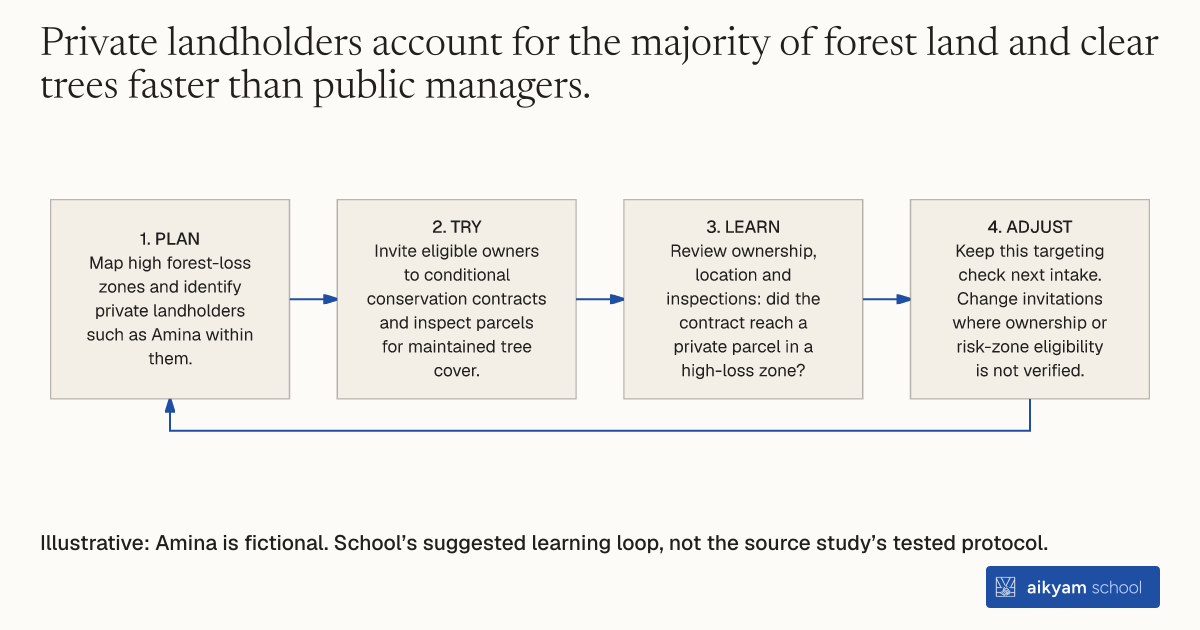
Try, learn and adjust
Check conservation invitations reach at-risk private landholders
- Plan: Map high forest-loss zones and identify private landholders such as Amina within them.
- Try: Invite eligible owners to conditional conservation contracts and inspect parcels for maintained tree cover.
- Learn: Review ownership, location and inspections: did the contract reach a private parcel in a high-loss zone?
- Adjust: Keep this targeting check next intake. Change invitations where ownership or risk-zone eligibility is not verified.
Illustrative: Amina is fictional. School’s suggested learning loop, not the source study’s tested protocol.
See source →School’s suggested, untested loop. Observe ownership, historical loss, contract conditions and tree cover; do not infer what an individual would otherwise clear.
How
When to use
Standard conservation programs allocate payments uniformly across public and private land. Public land often experiences lower clearing rates, while private landholders face higher economic pressures to clear forests. Targeting payments to private landholders in high-loss zones ensures conservation funds reach land at active risk of clearing.
Target conservation payment programs to private landholders operating in areas experiencing high forest loss.
- Map regional forest cover to identify zones experiencing high historical forest loss.
- Filter land ownership records to isolate private landholders within identified high-loss zones.
- Invite eligible private landholders to apply for conditional conservation payments.
- Issue conservation contracts that pay landholders to refrain from clearing forest land.
- Inspect private forest parcels periodically to verify that landowners maintain tree cover.
Why it works
Selecting participants who face high clearing risks ensures payments change landholder behavior instead of paying for forest that would remain intact.
Example
Researchers in Uganda targeted PES payments to private landholders who managed 70 percent of national forests, ensuring payments went to landowners likely to clear trees without the program.
About the study
Participants
Human private landowners managing forest land in Uganda.
Study Design
Randomized Controlled Trial evaluating conditional cash transfers targeted specifically to private landowners in high forest loss regions.
Results
Paying private landowners to conserve forest reduced tree loss by 54 percent over two years at US$2.60 per ton of CO2 emissions avoided.