Try, learn and adjust
Check work patterns after seating changes
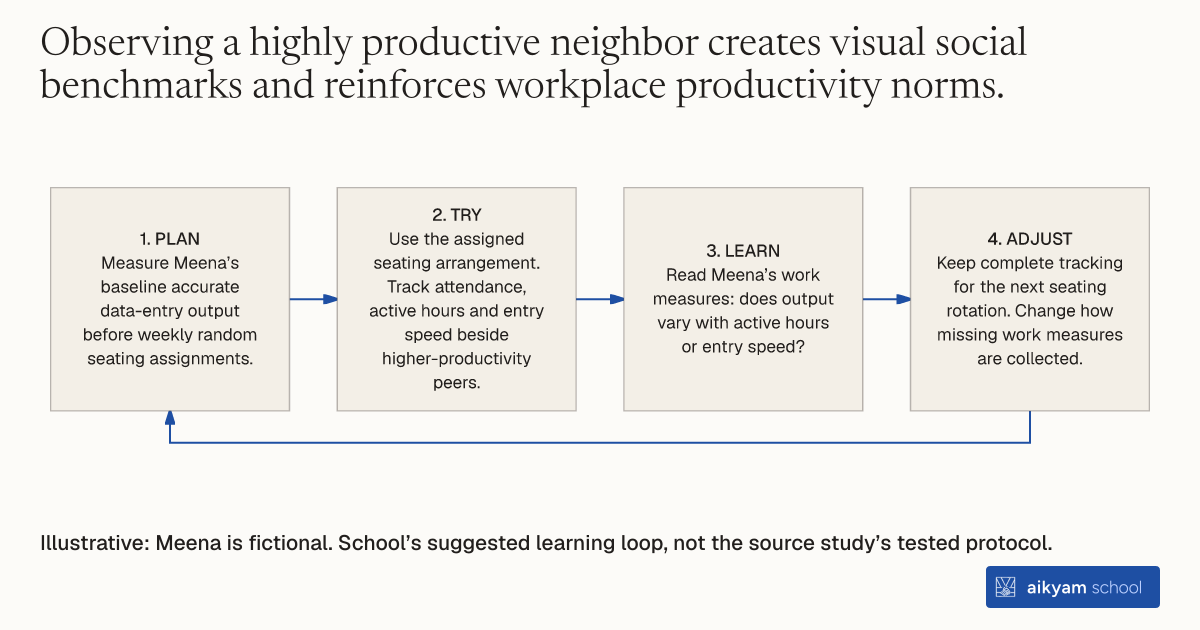
- Plan: Measure Meena’s baseline accurate data-entry output before weekly random seating assignments.
- Try: Use the assigned seating arrangement. Track attendance, active hours and entry speed beside higher-productivity peers.
- Learn: Read Meena’s work measures: does output vary with active hours or entry speed?
- Adjust: Keep complete tracking for the next seating rotation. Change how missing work measures are collected.
Illustrative: Meena is fictional. School’s suggested learning loop, not the source study’s tested protocol.
See source →School’s suggested, untested loop. Observe attendance, active hours, speed and output; preserve random seating assignments.
How
When to use
A firm needs to boost overall employee effort and output without changing monetary incentives. Individual productivity can suffer when workers lack real-time social benchmarks or active workplace accountability. Assigning workers to sit near highly productive colleagues leverages social spillovers to increase work time and productivity.
Rotate worker seating assignments to pair lower-performing or average employees next to high-performing peers.
- Measure individual worker productivity levels across standard work shifts.
- Categorize employees into productivity tiers based on average daily accurate field output.
- Assign seat locations randomly across the office floor on a regular schedule, such as weekly.
- Position workers directly adjacent to peers with above-average baseline productivity.
- Track daily attendance, active work hours, and entry speed for workers placed next to high-productivity peers.
Why it works
This peer presence deters non-work distractions and encourages employees to spend a higher proportion of their time actively working.
Example
A data entry firm in Mysore, India randomly assigned seating locations for 102 employees each week. Workers assigned to sit next to a peer with above-average productivity increased their own daily output by 5 percent, primarily by increasing total hours worked during the day.
About the study
Participants
102 data entry workers in Mysore, India.
Study Design
Randomized controlled trial randomly reassigning worker seating arrangements each week to measure peer productivity spillovers on individual daily output and commitment contract demand.
Results
Sitting near a peer with above-average productivity increased a worker's output by 5 percent, driven by increased work hours rather than entry speed, and raised the likelihood of choosing commitment contracts by 5 percentage points.