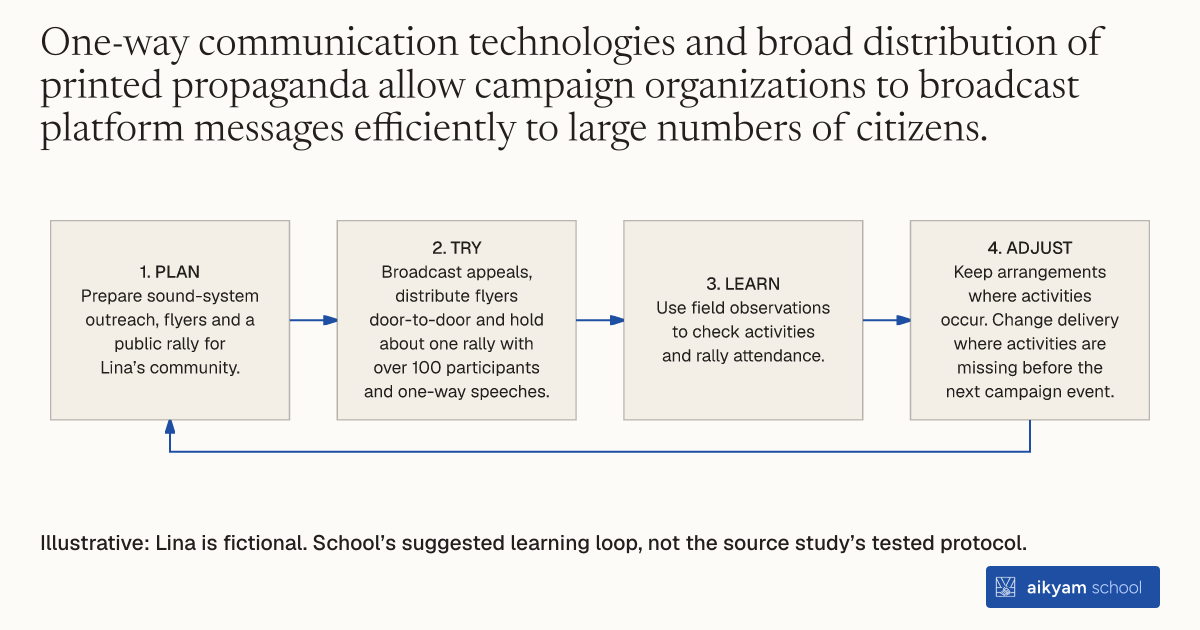
Try, learn and adjust
Check delivery of one-way campaign activities
- Plan: Prepare sound-system outreach, flyers and a public rally for Lina’s community.
- Try: Broadcast appeals, distribute flyers door-to-door and hold about one rally with over 100 participants and one-way speeches.
- Learn: Use field observations to check activities and rally attendance.
- Adjust: Keep arrangements where activities occur. Change delivery where activities are missing before the next campaign event.
Illustrative: Lina is fictional. School’s suggested learning loop, not the source study’s tested protocol.
See source →School’s suggested learning loop, not the source’s tested procedure. Observe campaign activities and attendance. These were comparison-area practices; observation does not establish their causal effect.
How
When to use
A political party needs to execute standard voter mobilization and broadcast its campaign message across local communities during an election. Conventional campaigns rely on passive one-way communication to reach broad citizen audiences without organizing interactive small-group meetings. Deploying mobile sound vehicles combined with door-to-door pamphlet distribution allows parties to distribute platform materials and solicit votes across entire neighborhoods.
Conduct a traditional one-way electoral campaign using mobile audio propaganda teams, door-to-door pamphlet distribution, and large party rallies.
- Deploy mobile campaign teams equipped with a roving sound system through neighborhood streets to broadcast audio appeals for votes.
- Send party volunteers door-to-door across households in target communities to distribute printed campaign flyers and promotional propaganda.
- Organize approximately one large public party rally per community exceeding 100 participants.
- Feature party leaders on stage delivering one-way speeches about the party policy platform without direct citizen participation or open debate.
Why it works
Passive rallies and roving sound systems establish visible party presence across entire electoral jurisdictions without requiring intensive per-person interaction.
Example
During the May 2013 congressional election in the Philippines, national party-lists Akbayan and Umalab Ka deployed roving sound systems, door-to-door canvassers distributing flyers, and public rallies in control barangays across Metro Manila and Calabarzon. Four field researchers from the Center for Popular Empowerment monitored these activities across control communities. In these standard one-way campaign areas, Akbayan achieved a 4.897 percent vote share and Umalab Ka received a 0.253 percent vote share.
About the study
Participants
39 randomly selected barangays across 13 municipalities in the National Capital Region and Calabarzon region of the Philippines, covering precinct-level voting records for 1,082 surveyed voters.
Study Design
Randomized field experiment comparing standard business-as-usual one-way campaigning in control barangays against interactive town-hall deliberative campaigns in treatment barangays, evaluated using official COMELEC precinct data and post-election surveys.
Results
Traditional one-way campaigning in control barangays resulted in a combined average party-list vote share of 2.397 percent (4.897 percent for Akbayan and 0.253 percent for Umalab Ka), serving as the baseline against which town-hall deliberative campaigns achieved a 1.096 percentage point (46 percent) increase.