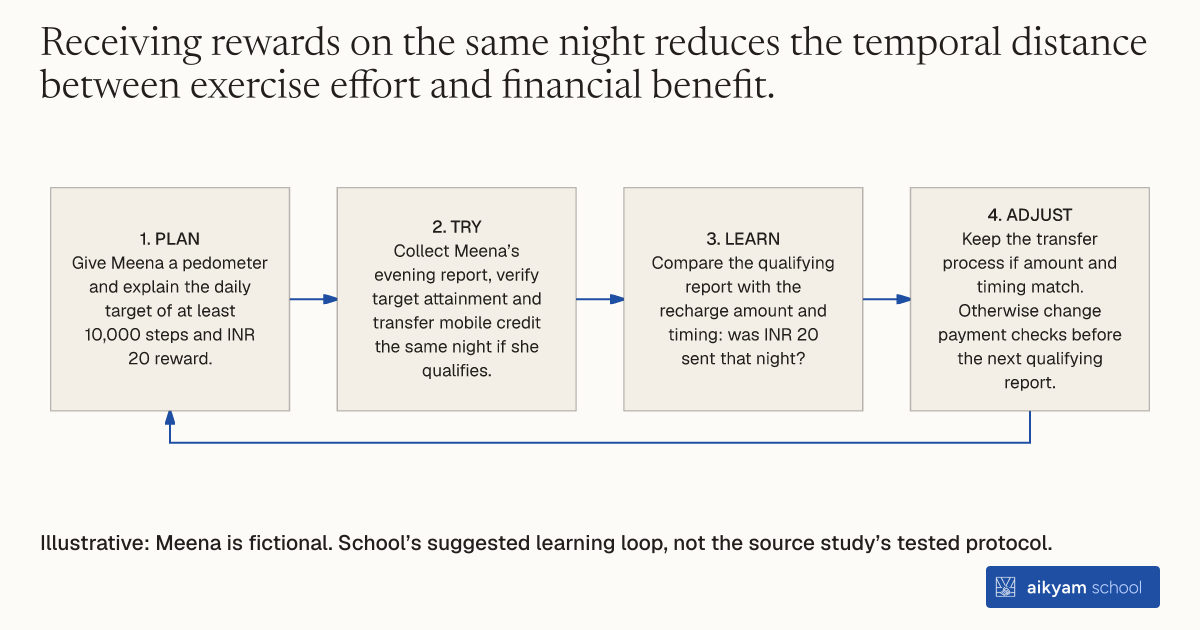
Try, learn and adjust
Check rewards arrive on the reported target night
- Plan: Give Meena a pedometer and explain the daily target of at least 10,000 steps and INR 20 reward.
- Try: Collect Meena’s evening report, verify target attainment and transfer mobile credit the same night if she qualifies.
- Learn: Compare the qualifying report with the recharge amount and timing: was INR 20 sent that night?
- Adjust: Keep the transfer process if amount and timing match. Otherwise change payment checks before the next qualifying report.
Illustrative: Meena is fictional. School’s suggested learning loop, not the source study’s tested protocol.
See source →School’s suggested, untested loop: observe qualifying reports, recharge amounts and same-night timing; no health outcome is assumed.
How
When to use
Urban adults managing diabetes or high blood sugar often delay physical activity due to immediate effort costs. Delivering immediate, same-day monetary rewards provides present motivation when daily step goals are achieved. This method serves urban diabetics and pre-diabetics who benefit from immediate reinforcement rather than delayed weekly or monthly payments.
Pay participants a fixed monetary incentive on the exact night they meet and report their daily step target.
- Provide pedometers to program participants to monitor daily walking progress.
- Establish a daily target of walking 10,000 steps or more.
- Collect daily step count reports every evening through an automated calling system.
- Verify whether the participant met the daily step target on that day.
- Transfer INR 20 (US$0.33) in mobile recharge on the same night the target is met and reported.
Why it works
Instant feedback provides immediate gratification, helping individuals overcome short-term inertia to exercise daily.
Example
In Tamil Nadu, India, researchers tested a daily payment contract with urban diabetics and pre-diabetics who received INR 20 (US$0.33) via mobile recharge on the same night they reported achieving 10,000 steps during a twelve-week evaluation.
About the study
Participants
3,192 urban diabetics and pre-diabetics in Tamil Nadu, India; average age almost 50 years; 58 percent male.
Study Design
12-week randomized controlled trial evaluating physical activity incentive structures with daily step reporting.
Results
Participants across incentive groups reached the step target on 49 percent of days compared to 29 percent for monitoring controls, increasing daily walking by 1,270 steps.