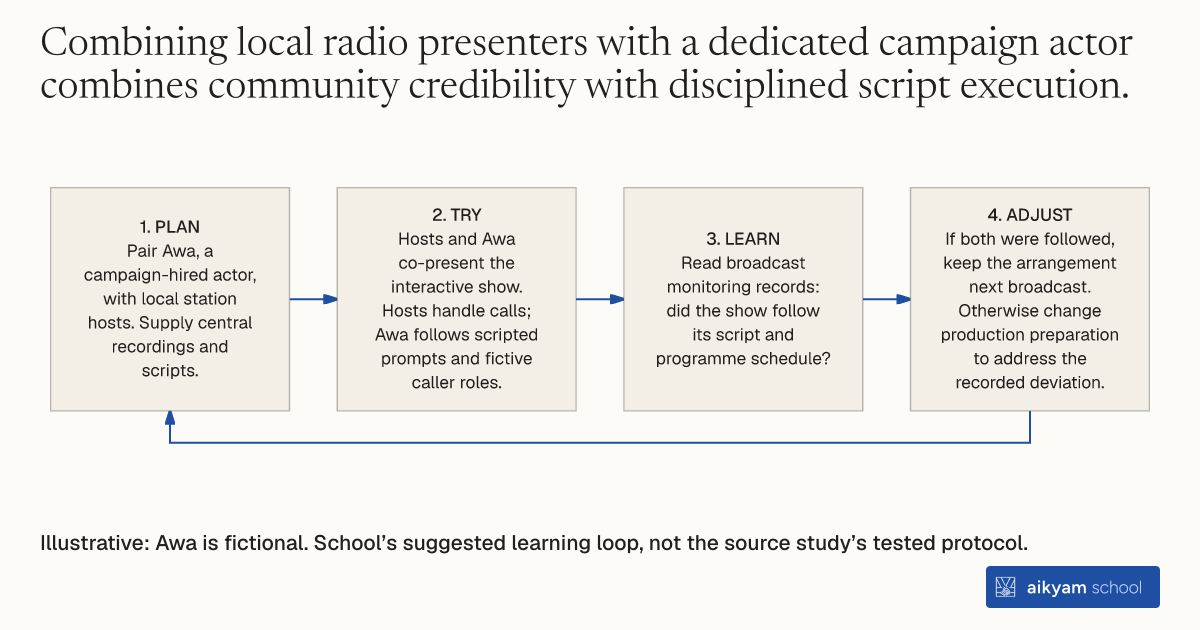
Try, learn and adjust
Check that joint broadcasts follow scripts and schedules
- Plan: Pair Awa, a campaign-hired actor, with local station hosts. Supply central recordings and scripts.
- Try: Hosts and Awa co-present the interactive show. Hosts handle calls; Awa follows scripted prompts and fictive caller roles.
- Learn: Read broadcast monitoring records: did the show follow its script and programme schedule?
- Adjust: If both were followed, keep the arrangement next broadcast. Otherwise change production preparation to address the recorded deviation.
Illustrative: Awa is fictional. School’s suggested learning loop, not the source study’s tested protocol.
See source →Observe script adherence and broadcast timing. This check does not establish health effects.
How
When to use
In mass media health campaigns, relying solely on local station staff can result in inconsistent messaging, while relying exclusively on external productions can reduce local audience trust and station ownership. Program implementation teams need a collaborative model to produce high-quality, standardized interactive health programming. Pairing local station journalists with a professional actor hired by the campaign ensures both local familiarity and scripted technical accuracy across broadcast sites.
Produce interactive radio programs through structured collaboration between local station staff and campaign-hired actors using central scripts and recordings.
- Central campaign staff create audio recordings of 90-second spots and write detailed scripts for weekly interactive radio programs.
- Campaign managers recruit and hire a professional actor, typically a woman, for each participating local radio station.
- Central producers distribute pre-recorded audio spots and detailed program scripts to local radio station employees.
- Local station hosts co-present weekly 1-hour interactive phone-in shows alongside the hired actor during peak listening hours.
- Station employees facilitate live audience phone calls while the hired actor executes scripted prompts and fictive caller roles.
- Campaign field teams closely monitor broadcasts to ensure adherence to detailed scripts and program schedules.
Why it works
Local hosts maintain familiar station rapport, while hired actors ensure sensitive health topics and complex misconceptions are presented accurately without script deviations.
Example
In Burkina Faso, Development Media International partnered with 8 treatment radio stations covering 5.1 million people to produce 195 annual hours of family planning content. DMI supplied pre-recorded 90-second spots and detailed scripts for three 1-hour weekly phone-in shows, which local station staff co-hosted with a female actor hired by DMI. This collaborative production increased weekly listening to behavior change programs from 13 percent to 23 percent.
About the study
Participants
7,515 women and 461 health clinics across 16 radio station clusters reaching 5.1 million people in rural Burkina Faso.
Study Design
Pairwise station-level randomized controlled trial evaluating a 2.5-year joint media campaign across 8 treatment radio stations.
Results
Joint broadcast production increased weekly listenership to health behavior change shows from 13 percent to 23 percent, expanded female airtime presence from 21 percent to 27 percent, and increased modern contraceptive prevalence by 5.9 percentage points.