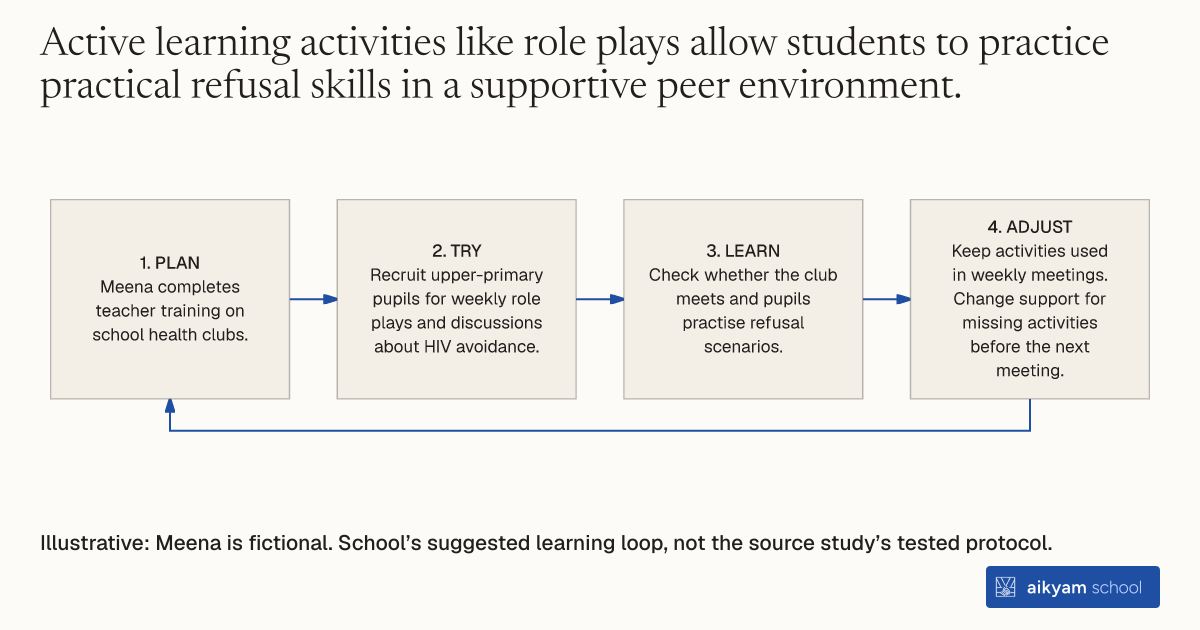
Try, learn and adjust
Check weekly health club activities
- Plan: Meena completes teacher training on school health clubs.
- Try: Recruit upper-primary pupils for weekly role plays and discussions about HIV avoidance.
- Learn: Check whether the club meets and pupils practise refusal scenarios.
- Adjust: Keep activities used in weekly meetings. Change support for missing activities before the next meeting.
Illustrative: Meena is fictional. School’s suggested learning loop, not the source study’s tested protocol.
See source →Observe club meetings and role plays. School suggests this learning loop; club activity alone does not show reduced pregnancy.
How
When to use
Primary school students often lack interactive spaces to practice refusing risky sexual behavior and discussing disease prevention. Standard lecture formats do not give pupils opportunities to act out real-world social pressures or internalize risk avoidance skills. School health clubs create extracurricular venues where upper-primary students learn risk avoidance through peer role plays and structured exercises.
Establish primary school health clubs where trained teachers guide upper-primary students in practicing HIV avoidance through interactive role plays.
- Primary school teachers complete in-service training on setting up extracurricular health clubs and facilitating active health education.
- Instructors recruit upper-primary students to join weekly extracurricular health club sessions on school grounds.
- Teachers design interactive learning activities, including peer role plays that simulate peer pressure and moral refusal scenarios.
- Students act out strategies to say no to pre-marital sexual proposals and discuss disease transmission risks.
- Teachers guide weekly discussions on HIV biology, local impact, and moral risk avoidance during club meetings.
Why it works
Engaging pupils directly in extracurricular health clubs reinforces classroom lessons on risk avoidance and makes health messages memorable.
Example
In 163 primary schools in Western Kenya whose teachers received in-service HIV curriculum training in 2003, 86 percent successfully established active health clubs within one year. Two years after training, students in these schools scored higher on standardized HIV knowledge tests than students in control schools.
About the study
Participants
328 primary schools (163 treatment schools and 165 control schools) in Western Kenya, covering upper-primary students with an average age of 15 years.
Study Design
A randomized controlled trial evaluated the program by tracking health club formation rates at 12 months and assessing student HIV knowledge scores at 24 months post-training across treatment and comparison schools.
Results
Teacher training led 86 percent of treated schools to establish health clubs within one year, and increased student scores on HIV transmission knowledge tests after two years, though it did not reduce teen pregnancy rates (0.6 percentage point difference).