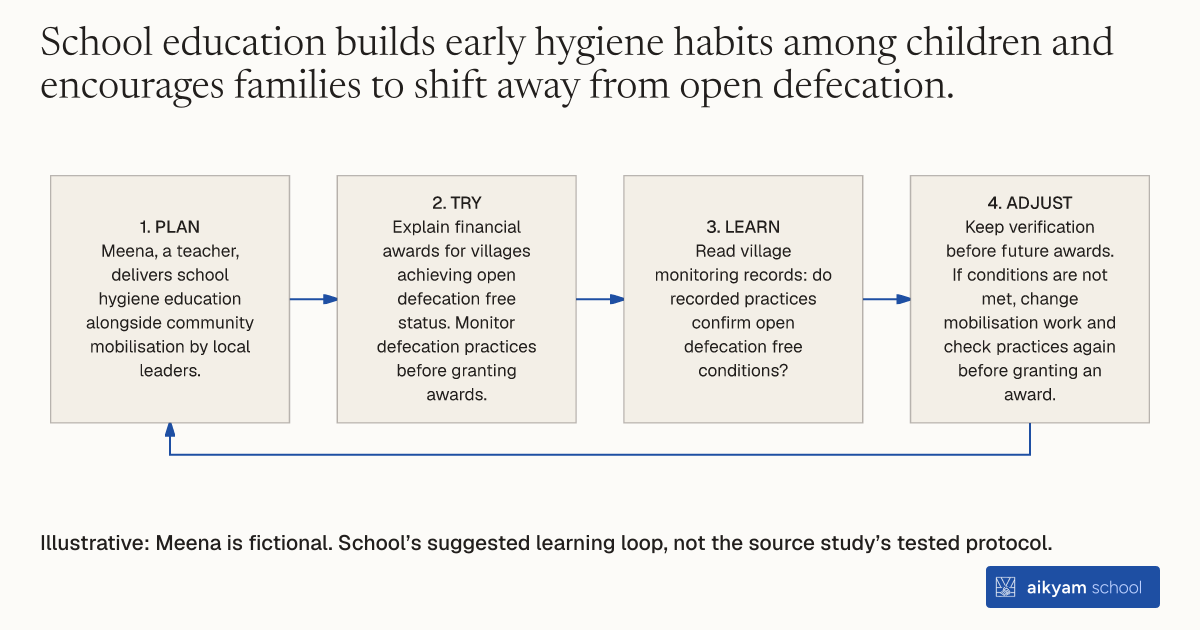
Try, learn and adjust
Check village sanitation before granting awards
- Plan: Meena, a teacher, delivers school hygiene education alongside community mobilisation by local leaders.
- Try: Explain financial awards for villages achieving open defecation free status. Monitor defecation practices before granting awards.
- Learn: Read village monitoring records: do recorded practices confirm open defecation free conditions?
- Adjust: Keep verification before future awards. If conditions are not met, change mobilisation work and check practices again before granting an award.
Illustrative: Meena is fictional. School’s suggested learning loop, not the source study’s tested protocol.
See source →School’s suggested learning loop, not a source-tested procedure. Observe hygiene education, village practices and award verification; this does not establish separate effects of education or awards.
How
When to use
Open defecation and poor hygiene practices spread diarrheal illness among young children in rural communities. Deep-seated cultural habits and social norms keep families from using toilets even when latrines exist. This approach combines school hygiene education with community-wide financial awards to motivate social norm shifts toward toilet usage.
Promote community-wide toilet adoption by combining school hygiene education with village financial performance awards.
- School teachers deliver sanitation and hygiene education to students in local schools.
- Community leaders conduct social mobilization exercises to encourage village-wide sanitation behavior change.
- Government agencies offer financial awards to villages that successfully achieve open defecation free status.
- Program officers monitor village defecation practices to confirm open defecation free conditions before granting awards.
Why it works
Financial awards create village-wide social motivation to stop open defecation collectively.
Example
In rural Madhya Pradesh, India, researchers evaluated the Total Sanitation Campaign across 40 treatment villages where school hygiene education, community motivation, and village awards were introduced. The intervention increased the share of households with WHO-compliant improved sanitation facilities to 41.4 percent, compared to 22.4 percent in comparison villages.
About the study
Participants
80 rural villages in Madhya Pradesh, India, focusing on households with children under 24 months of age and the rural population.
Study Design
Randomized evaluation across 80 villages where 40 villages received the Total Sanitation Campaign intervention and 40 villages served as comparison.
Results
The proportion of households with improved sanitation facilities meeting WHO standards increased to 41.4 percent (19 percentage points higher than comparison villages), and daily open defecation decreased by 11 to 12 percent among men and women, though child health outcomes remained unchanged.