Procedure
Spare parts tracking
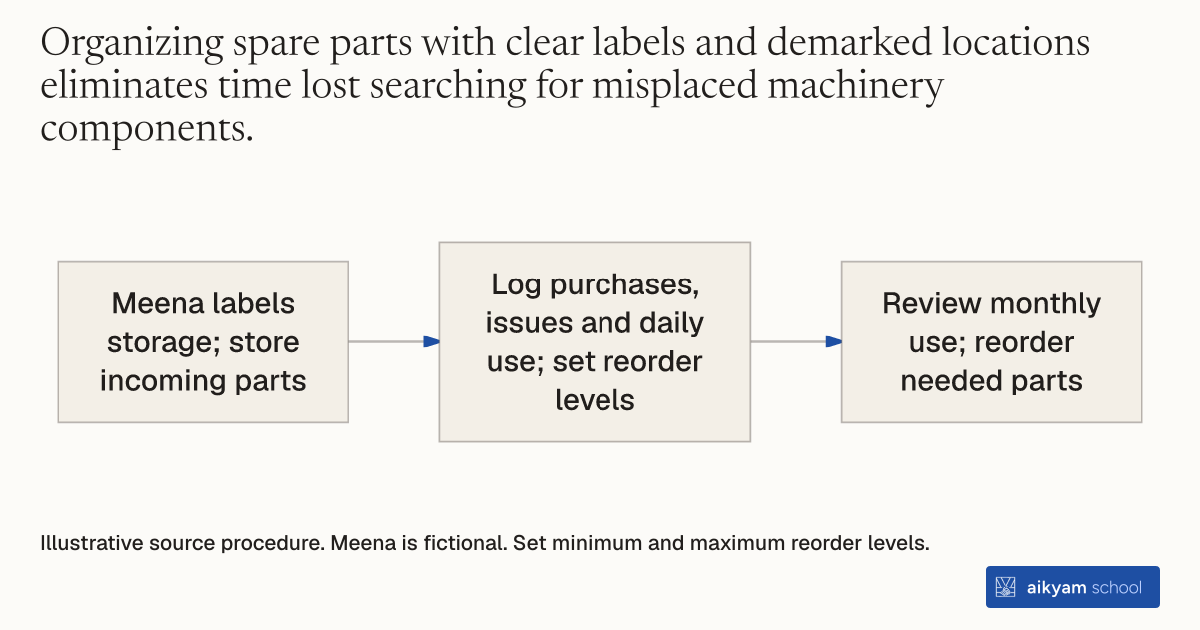
- Meena labels storage; store incoming parts
- Log purchases, issues and daily use; set reorder levels
- Review monthly use; reorder needed parts
Illustrative source procedure. Meena is fictional. Set minimum and maximum reorder levels.
See source →How
When to use
Manufacturing facilities often store machine spare parts in unorganized bins without recording purchases or tracking consumption. This method establishes demarked storage locations, physical labels, and continuous purchase logging for all factory spare parts. It helps inventory managers control maintenance expenses and prevent costly loom downtime caused by missing spare parts.
Organize factory spare parts in demarked storage spaces and record all parts purchases and consumption.
- Designate specific, demarcated storage locations and clear physical labels for every machine spare part in the warehouse.
- Store all incoming spare components in their designated labeled locations immediately upon delivery.
- Log all spare parts purchases, issues, and daily consumption in a centralized inventory tracking ledger.
- Apply scientific inventory modeling methods to define minimum and maximum reorder norms for critical machine spares.
- Review spare parts consumption records monthly to monitor maintenance expenditures and reorder necessary replacement parts.
Why it works
Logging daily purchases and consumption allows plant managers to track maintenance costs and prevent stockouts of critical machine parts.
Example
In 2008, international consultants introduced systematic spare parts labeling and purchase tracking across Indian textile plants near Mumbai. Systematic spare parts storage grew from 10% adoption in 2008 to 40% in 2017, with zero adopting plants dropping the practice after adoption.
About the study
Participants
28 manufacturing plants across 17 family-owned cotton weaving firms near Mumbai, India, averaging 270 employees, $8.5 million in assets, and $7.5 million in annual sales.
Study Design
Randomized Controlled Trial (RCT) tracking 38 management practices across treatment and control plants from 2008 to 2017.
Results
Systematic spare parts storage in demarked, labeled locations grew from 10% in 2008 to 20% in 2011 and 40% in 2017, with a 0% drop rate among adopters, while spare parts consumption recording was maintained in 35% of plants in 2017.