Try, learn and adjust
Check yarn age before opening fresh stock
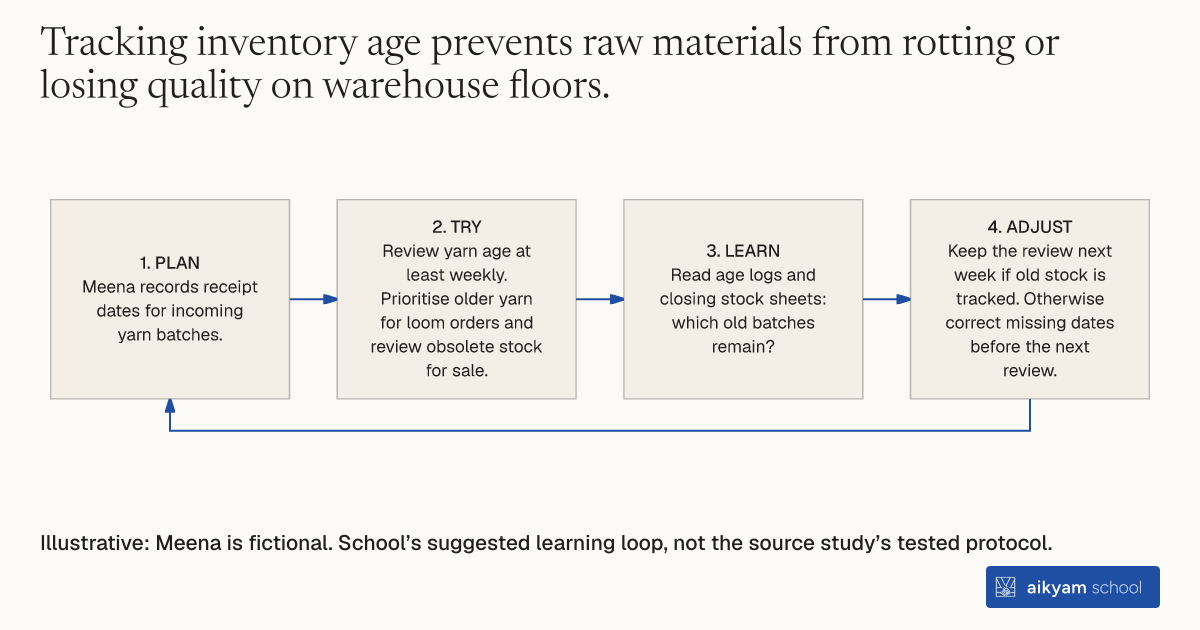
- Plan: Meena records receipt dates for incoming yarn batches.
- Try: Review yarn age at least weekly. Prioritise older yarn for loom orders and review obsolete stock for sale.
- Learn: Read age logs and closing stock sheets: which old batches remain?
- Adjust: Keep the review next week if old stock is tracked. Otherwise correct missing dates before the next review.
Illustrative: Meena is fictional. School’s suggested learning loop, not the source study’s tested protocol.
See source →Observe yarn receipt dates, age and closing stock. School suggests this learning loop; it is not the source’s tested procedure.
How
When to use
Manufacturing plants often store raw yarn and spare parts without recording receipt dates or tracking stock age. This practice introduces systematic monitoring of inventory age and structured protocols for selling or using obsolete materials. It helps factory directors and inventory managers clear valuable space and recover capital tied up in dead stock.
Establish systematic yarn aging logs and stock disposal routines to prevent material deterioration and recover working capital.
- Warehouse clerks log every incoming yarn batch and record receipt dates on physical inventory cards.
- Inventory managers monitor yarn stock age at least weekly to identify slow-moving or outdated materials.
- Factory teams mark closing stock levels on weekly tracking sheets to maintain visibility over remaining raw materials.
- Production planners prioritize older yarn batches for active loom orders before opening fresh stock.
- Management conducts regular stock reviews to identify dead inventory and sell obsolete yarn to outside buyers.
Why it works
Establishing clear stock disposal routines frees up factory floor space and liquidates idle capital.
Example
In 2008, international consultants introduced yarn aging tracking and stock disposal systems across experimental textile plants in Mumbai, India. Monitoring yarn stock aging grew from 28% adoption in 2008 to 72% in 2017, while stock disposal systems reached 78% adoption in 2011 with only 7% of adopters ever dropping the practice.
About the study
Participants
28 manufacturing plants across 17 family-owned cotton weaving firms near Mumbai, India, averaging 270 employees, $8.5 million in assets, and $7.5 million in annual sales.
Study Design
Randomized Controlled Trial (RCT) tracking 38 management practices across treatment and control plants from 2008 to 2017.
Results
Yarn aging monitoring increased from 28% in 2008 to 53.8% in 2011 and 72% in 2017, while old stock disposal systems grew from 5% in 2008 to 78% in 2011 and 56% in 2017.