Research analysis
Estimate how impacts vary by community
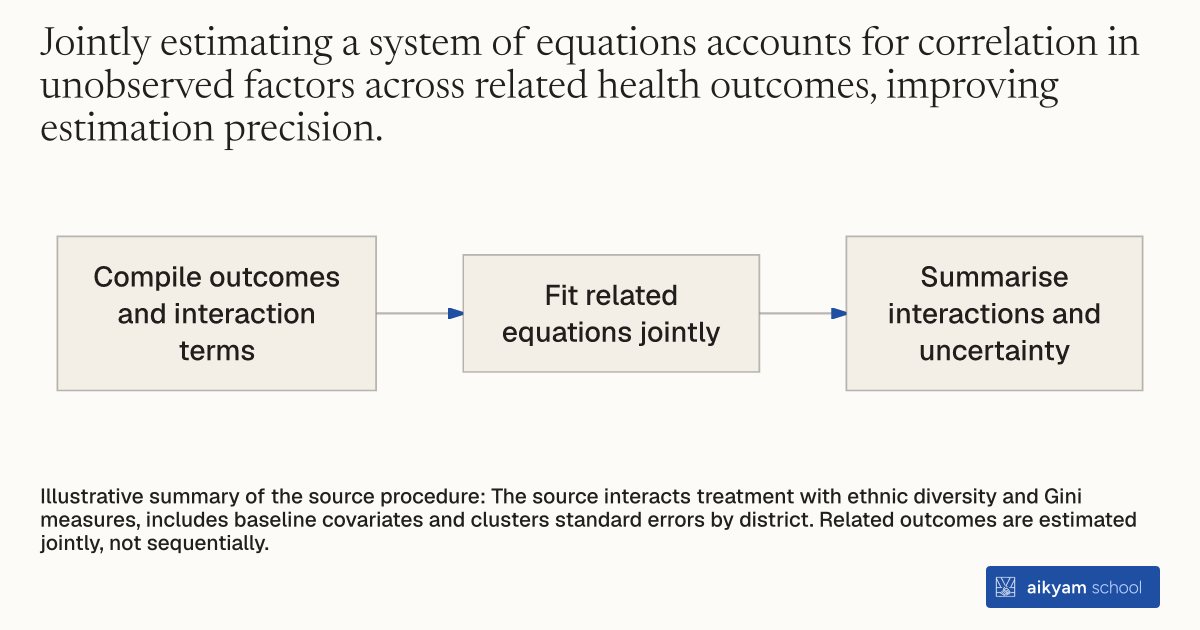
- Compile outcomes and interaction terms
- Fit related equations jointly
- Summarise interactions and uncertainty
Illustrative summary of the source procedure: The source interacts treatment with ethnic diversity and Gini measures, includes baseline covariates and clusters standard errors by district. Related outcomes are estimated jointly, not sequentially.
See source →How
When to use
Primary health care evaluations often assess multiple correlated outcome measures across communities with varying social conditions. Standard single-equation regressions fail to capture cross-equation error correlations and overall standardized treatment interaction effects across multiple health service metrics. This method estimates a system of seemingly unrelated regressions to evaluate how social heterogeneity interacts with community monitoring interventions across multiple utilization and process outcomes.
Estimate a system of seemingly unrelated regressions to evaluate heterogeneous program impacts across multiple related service delivery outcomes.
- Econometricians compile a vector of outcome variables, including health utilization counts and community action indices across treatment and control facilities.
- Econometricians construct interaction terms between the treatment assignment indicator and social heterogeneity variables, specifically ethno-linguistic fractionalization and community Gini coefficients.
- Econometricians specify a system of regression equations linking outcomes to treatment indicators, social heterogeneity interactions, and baseline facility covariates.
- Econometricians estimate the regression system jointly to account for cross-equation error correlations across all outcome regressions.
- Econometricians cluster standard errors at the district level to match the unit of variation for ethnic fractionalization data.
- Econometricians calculate average standardized interaction effects across the outcome equations to quantify overall heterogeneous treatment impacts.
Why it works
Calculating average standardized interaction effects allows researchers to summarize overall treatment heterogeneity across multiple service delivery metrics.
Example
Researchers applied a SUR system to 50 public primary health dispensaries in Uganda across four health utilization outcomes. The average standardized interaction effect between treatment and ethno-linguistic fractionalization was -3.87 (standard error 1.30), showing that treatment impacts were significantly smaller in ethnically fragmented communities.
About the study
Participants
50 primary health care dispensaries and their catchment areas across 9 rural districts in Uganda.
Study Design
System of seemingly unrelated regressions across multiple related outcome equations with district-clustered standard errors and baseline facility covariates.
Results
The estimated average standardized interaction effect for ethnic fractionalization across utilization outcomes was -3.87 (standard error 1.30), and for the community ACTION index, the interaction coefficient was -3.05 (standard error 1.43).