Try, learn and adjust
Check volunteer-led community mobilisation
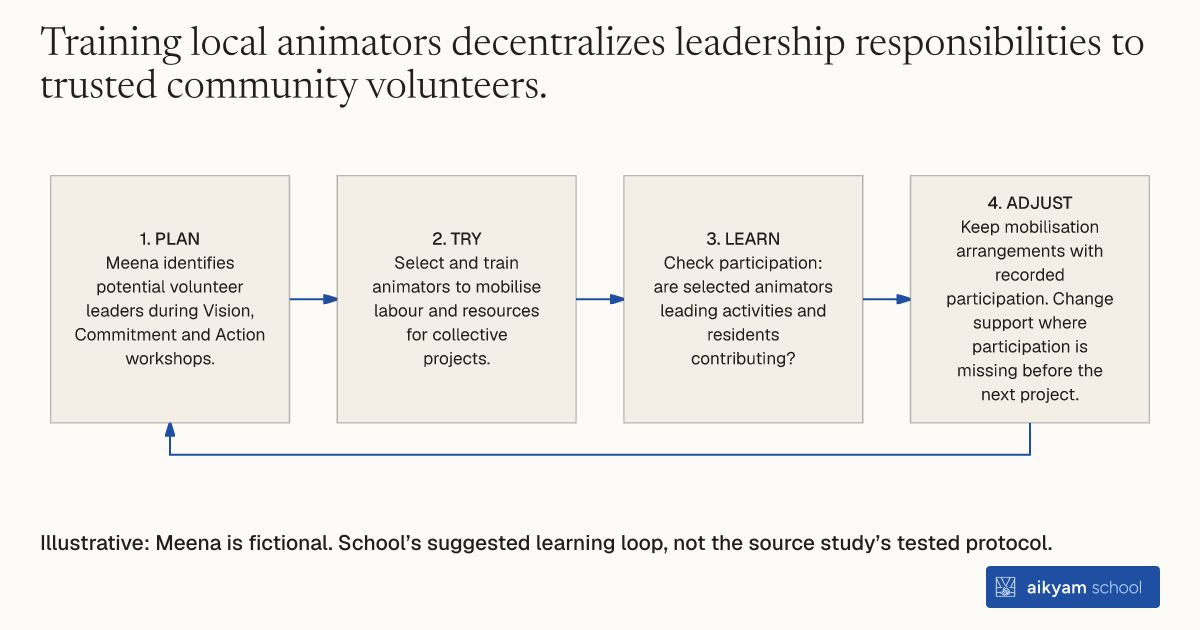
- Plan: Meena identifies potential volunteer leaders during Vision, Commitment and Action workshops.
- Try: Select and train animators to mobilise labour and resources for collective projects.
- Learn: Check participation: are selected animators leading activities and residents contributing?
- Adjust: Keep mobilisation arrangements with recorded participation. Change support where participation is missing before the next project.
Illustrative: Meena is fictional. School’s suggested learning loop, not the source study’s tested protocol.
See source →Observe animator activity and project contributions. School suggests this learning loop; it is not the source’s tested procedure.
How
When to use
Rural community development initiatives require dedicated local leadership to mobilize residents and lead collective projects. Selection and training of volunteer animators recruits motivated individuals to serve as active community organizers. The method serves rural villages seeking to build persistent local leadership capacity for community action.
Identify and train volunteer animators to lead community mobilization and organize local development projects.
- Identify community members who demonstrate strong leadership skills during initial Vision, Commitment and Action workshops.
- Select these identified individuals to serve as volunteer leaders called animators.
- Provide subsequent specialized leadership and organizational training to the selected animators.
- Task animators with mobilizing other community members to contribute labor and resources to collective projects.
- Deploy animators to lead specific development activities and community action projects across the village grouping.
Why it works
Animators build local organizational capacity and maintain ongoing motivation for collective self-governance.
Example
In Eastern Ghana, The Hunger Project identified and trained volunteer animators across 51 assigned village groupings. In villages that accepted treatment, 2.7 percent of adults served as volunteer animators and 5.0 percent of adults contributed directly to animator-led collective projects.
About the study
Participants
2,744 households across 97 village groupings in 13 districts of Eastern Ghana.
Study Design
Randomized evaluation using public lotteries to assign 51 village groupings to treatment and 46 to control over a five-year period.
Results
Being selected as an animator reached 2.7 percent of adults in treated villages, increasing contributions to epicenter programming by 58.5 GHC, but decreased overall non-epicenter public goods contributions by 10 GHC.