Try, learn and adjust
Check community action plans use local resources
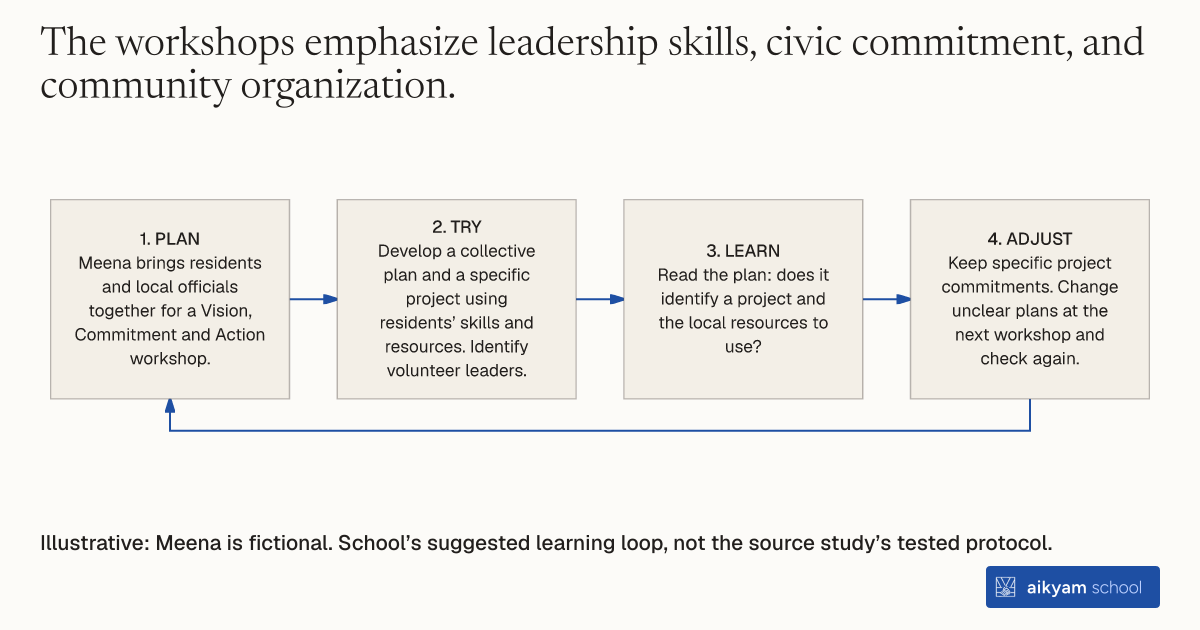
- Plan: Meena brings residents and local officials together for a Vision, Commitment and Action workshop.
- Try: Develop a collective plan and a specific project using residents’ skills and resources. Identify volunteer leaders.
- Learn: Read the plan: does it identify a project and the local resources to use?
- Adjust: Keep specific project commitments. Change unclear plans at the next workshop and check again.
Illustrative: Meena is fictional. School’s suggested learning loop, not the source study’s tested protocol.
See source →Observe action plans, participation and local resource commitments. School suggests this learning loop; it is not the source’s tested procedure.
How
When to use
Rural communities in developing countries often lack civic commitment and local leadership capacity. Vision, Commitment and Action workshops help community members and local officials build leadership skills and plan local development projects. The method serves rural citizens who want to organize collective development using their own resources.
Conduct intensive participatory workshops to train local leaders and build community action plans.
- Convene community members and local government officials for an intensive Vision, Commitment and Action workshop.
- Ask workshop participants to develop a collective community action plan for local development.
- Require participants to create a specific action plan for a project using their own skills and resources.
- Identify community members with strong leadership skills during the workshop to serve as volunteer animators.
- Repeat Vision, Commitment and Action workshops regularly throughout the engagement period.
Why it works
Participants reflect on individual actions and work together to reduce dependency on outside resources.
Example
The Hunger Project conducted Vision, Commitment and Action workshops across 51 assigned village groupings in Eastern Ghana. In communities that accepted treatment, 11.1 percent of adults attended a workshop session and participants attended an average of 0.406 workshops in a 12-month period.
About the study
Participants
2,744 households across 97 village groupings in 13 districts of Eastern Ghana.
Study Design
Randomized evaluation using public lotteries to assign 51 village groupings to treatment and 46 to control over a five-year period.
Results
Workshop exposure reached 11.1 percent of adults in treated villages and improved perceived village leadership quality by 0.211 standard deviations, but decreased voluntary household contributions to other public goods by 10 GHC.