Try, learn and adjust
Check students complete the self-assessment
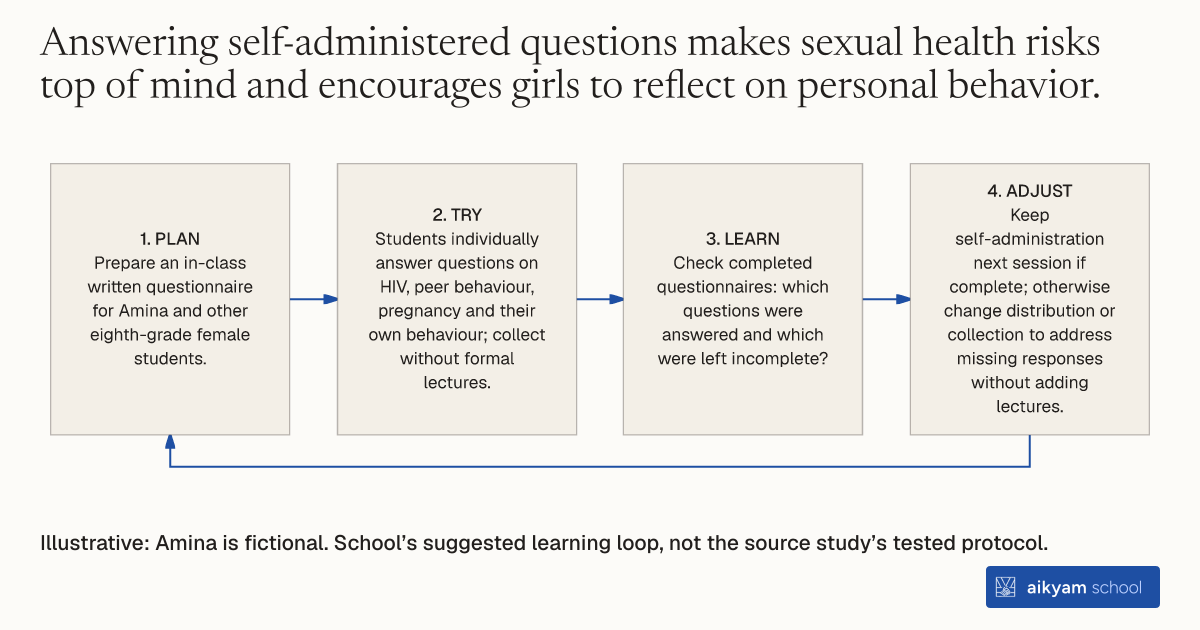
- Plan: Prepare an in-class written questionnaire for Amina and other eighth-grade female students.
- Try: Students individually answer questions on HIV, peer behaviour, pregnancy and their own behaviour; collect without formal lectures.
- Learn: Check completed questionnaires: which questions were answered and which were left incomplete?
- Adjust: Keep self-administration next session if complete; otherwise change distribution or collection to address missing responses without adding lectures.
Illustrative: Amina is fictional. School’s suggested learning loop, not the source study’s tested protocol.
See source →School’s suggested, untested learning loop. Observe questionnaire completion; the source describes a questionnaire without additional instruction. Do not assume behaviour change.
How
When to use
Adolescent students in school settings may lack accurate awareness of sexual health risks and peer behaviors. Delivering a light-touch self-administered questionnaire helps make health risks top of mind without requiring complex curricula. This approach targets eighth-grade female students facing risk of unplanned pregnancy and sexually transmitted infections.
Administer a brief self-assessment questionnaire to students in school to make sexual health risks top of mind.
- School staff distribute an in-class written questionnaire to eighth-grade female students during one or more sessions in the school year.
- Students complete questions individually regarding their HIV knowledge, beliefs about peer sexual behavior, pregnancy, and own sexual behavior.
- Facilitators collect completed questionnaires without delivering formal lectures or explicit instruction.
Why it works
This reflection prompts adolescents to consider the risks associated with unprotected sex and change their behaviors accordingly.
Example
In Cameroon during 2010–2011, eighth-grade female students completed an in-class questionnaire on HIV knowledge and behavior, which reduced pregnancy rates over a one-year follow-up.