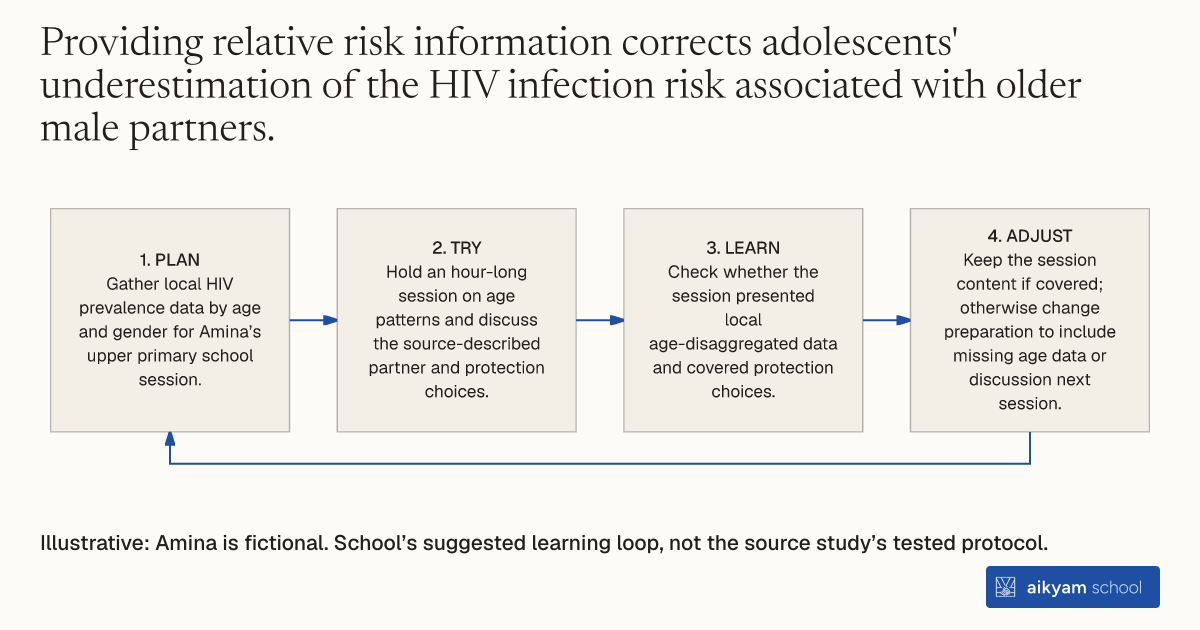
Try, learn and adjust
Check risk information reflects local age patterns
- Plan: Gather local HIV prevalence data by age and gender for Amina’s upper primary school session.
- Try: Hold an hour-long session on age patterns and discuss the source-described partner and protection choices.
- Learn: Check whether the session presented local age-disaggregated data and covered protection choices.
- Adjust: Keep the session content if covered; otherwise change preparation to include missing age data or discussion next session.
Illustrative: Amina is fictional. School’s suggested learning loop, not the source study’s tested protocol.
See source →School’s suggested, untested learning loop. Observe information coverage. This suggested delivery loop is not clinical guidance or a claim that younger partners are risk-free.
How
When to use
Adolescent female students may enter relationships with older men who pose a higher risk of HIV transmission without realizing how risk varies by age. Providing specific information on HIV prevalence across age groups helps girls make informed partner and protection choices. This approach targets upper primary or eighth-grade female students in school settings.
Deliver an in-school information campaign detailing local HIV prevalence rates across age and gender groups.
- Program facilitators gather regional data showing HIV prevalence among males and females broken down by age.
- Facilitators schedule an hour-long, in-school session for upper primary female students during the school year.
- Facilitators present age-disaggregated HIV data highlighting the increased prevalence among older men.
- Facilitators discuss safer relationship options, including choosing younger partners or using condoms consistently with older partners.
Why it works
Aligning risk perceptions with reality encourages girls to switch to younger, lower-risk partners or use protection.
Example
In Kenya from 2003 to 2005, an hour-long in-school session conveying age-disaggregated HIV prevalence to eighth-grade female students reduced childbearing over twelve months by 1.5 percentage points (28 percent) and reduced births with partners five or more years older by 62 percent.