Try, learn and adjust
Check external HIV education sessions are delivered
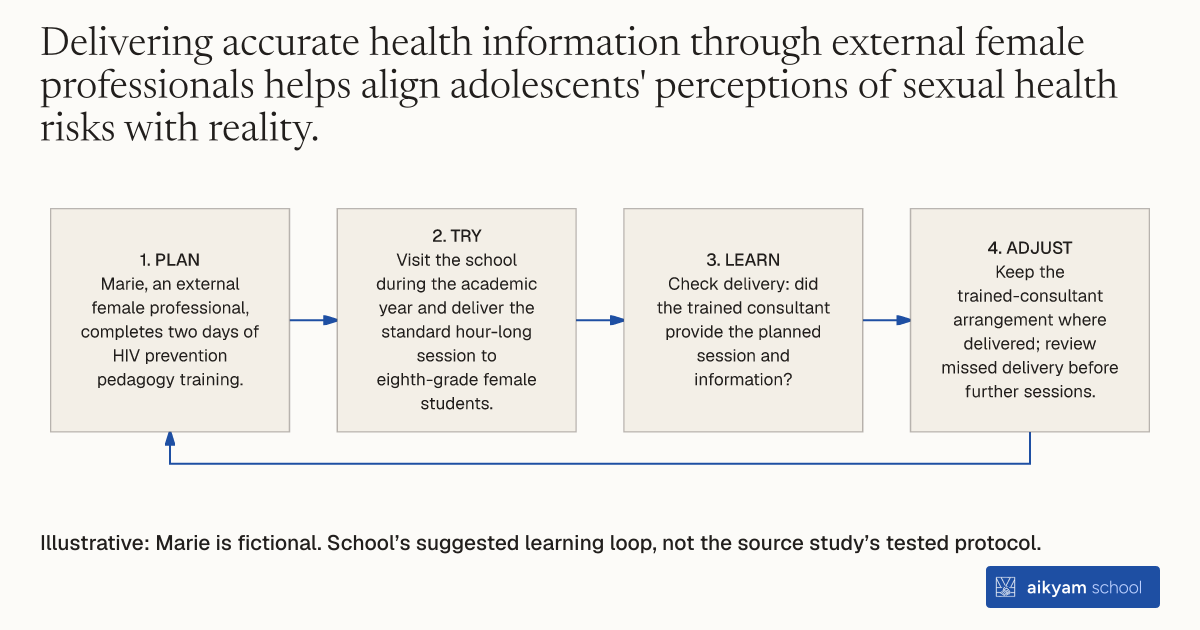
- Plan: Marie, an external female professional, completes two days of HIV prevention pedagogy training.
- Try: Visit the school during the academic year and deliver the standard hour-long session to eighth-grade female students.
- Learn: Check delivery: did the trained consultant provide the planned session and information?
- Adjust: Keep the trained-consultant arrangement where delivered; review missed delivery before further sessions.
Illustrative: Marie is fictional. School’s suggested learning loop, not the source study’s tested protocol.
See source →School’s suggested loop, not a tested source procedure. Observe training and session delivery. This is not a clinical protocol or a pregnancy-impact test.
How
When to use
Adolescent female students in school settings face risks of unplanned pregnancy and HIV transmission due to gaps in health knowledge. Engaging external female professionals to deliver structured health sessions allows schools to communicate HIV prevention messages directly without relying solely on regular teaching staff. This approach targets eighth-grade female students in school environments.
Deploy trained external female professionals to conduct in-school HIV prevention education sessions for students.
- Program managers recruit female professionals to serve as external health consultants for participating schools.
- Consultants attend a two-day training workshop focused on HIV prevention education pedagogy.
- Trained female consultants visit schools during the academic year to conduct an hour-long, in-school health session.
- Consultants deliver standardized sexual and reproductive health information directly to eighth-grade female students.
Why it works
Clear information on health trade-offs encourages students to adopt safer behaviors and delay pregnancy.
Example
In Cameroon during 2010–2011, trained female professionals delivered hour-long in-school sessions on HIV prevention to eighth-grade female students aged 15 on average, which reduced the overall pregnancy rate over a one-year follow-up.