Try, learn and adjust
Check temporary work payments and completed assets
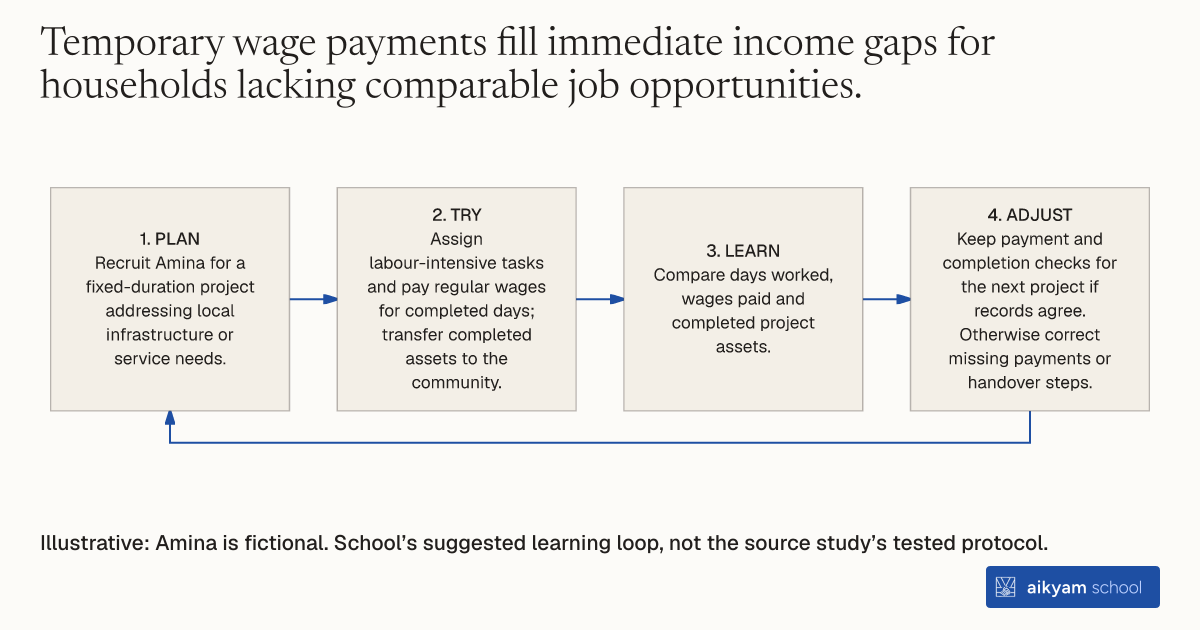
- Plan: Recruit Amina for a fixed-duration project addressing local infrastructure or service needs.
- Try: Assign labour-intensive tasks and pay regular wages for completed days; transfer completed assets to the community.
- Learn: Compare days worked, wages paid and completed project assets.
- Adjust: Keep payment and completion checks for the next project if records agree. Otherwise correct missing payments or handover steps.
Illustrative: Amina is fictional. School’s suggested learning loop, not the source study’s tested protocol.
See source →School’s suggested learning loop: observe workdays, wage payments and asset handover; this does not establish lasting employment benefits.
How
When to use
Address urgent unemployment and income gaps in low- and middle-income countries caused by poverty, climate shocks, or violent conflicts. Provide temporary, government-sponsored employment to impoverished workers who lack alternative job opportunities. Construct or repair community assets while distributing wage payments to local households.
Deliver short-term cash-for-work opportunities by organizing labor-intensive public works projects across targeted communities.
- Identify community infrastructure or service needs, such as building roads, digging irrigation canals, or cleaning public areas.
- Set program eligibility criteria and recruit local unemployed or underemployed individuals into fixed-duration work positions.
- Assign participants to labor-intensive construction or community projects for a defined temporary deployment period.
- Issue regular wage payments to participants for completed days of work.
- Transfer completed roads, irrigation systems, or amenities to the local community for long-term use.
Why it works
Simultaneous construction creates productive public goods that offer lasting amenities and economic utility to the broader community.
Example
In Sierra Leone, a government public works program recruited low-income participants to build community infrastructure projects paying $1.80 per day, boosting participant incomes during active program deployment.
About the study
Participants
Low-income participants across 13 randomized evaluations in low- and middle-income countries, including Sierra Leone, Côte d'Ivoire, and Egypt.
Study Design
Systematic review of randomized controlled trials measuring short-term employment rates, participant earnings during project deployment, and post-program outcomes.
Results
Seven of eight studies measuring short-term employment showed increased employment during the program, and all seven studies measuring short-term earnings reported higher earnings for participants during active deployment.