Research procedure
Limit recruitment to one man per household
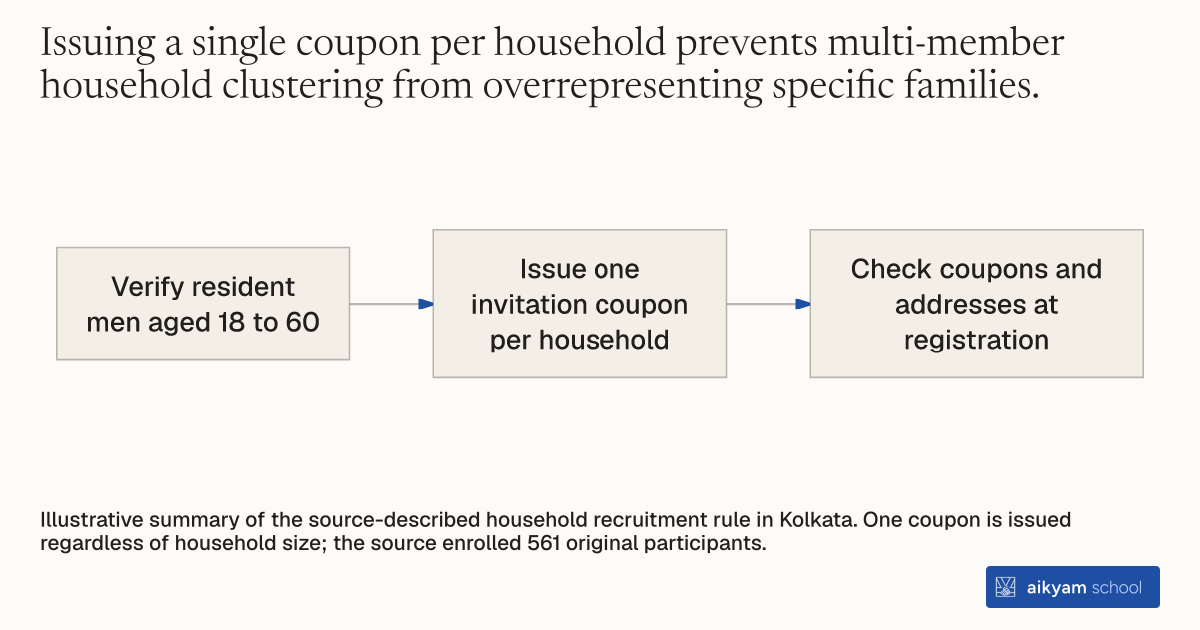
- Verify resident men aged 18 to 60
- Issue one invitation coupon per household
- Check coupons and addresses at registration
Illustrative summary of the source-described household recruitment rule in Kolkata. One coupon is issued regardless of household size; the source enrolled 561 original participants.
See source →How
When to use
Restrict recruitment eligibility to a single member per household when conducting door-to-door community sampling. This prevents overrepresentation of single households or family clusters in sample pools. Use this protocol when recruiting participants for labor studies or community programs.
Distribute a single non-transferable invitation coupon per visited residential unit to enforce one-participant-per-household sampling.
- Visit targeted residential households during door-to-door solicitation rounds.
- Verify household residency and identify adult males aged 18 to 60 residing in the dwelling.
- Issue exactly one invitation coupon per household unit regardless of total adult household size.
- Require arriving participants to present the issued coupon at the study site for registration.
- Record household addresses during intake to verify that no household submits multiple participants.
Why it works
This ensures the recruited sample reflects broad residential diversity across targeted neighborhoods.
Example
Field staff issued single invitation coupons during door-to-door visits in Kolkata, India. Enforcing a single-coupon limit across households yielded a final sample of 561 original male participants drawn from distinct residential units.
About the study
Participants
561 adult males from 561 distinct households in peri-urban Kolkata, India.
Study Design
Single-coupon household eligibility rule enforced during door-to-door solicitation across peri-urban neighborhoods.
Results
Successfully restricted participation to one eligible male per household, enrolling 561 distinct household representatives from a 37 percent recruitment yield.