Research steps
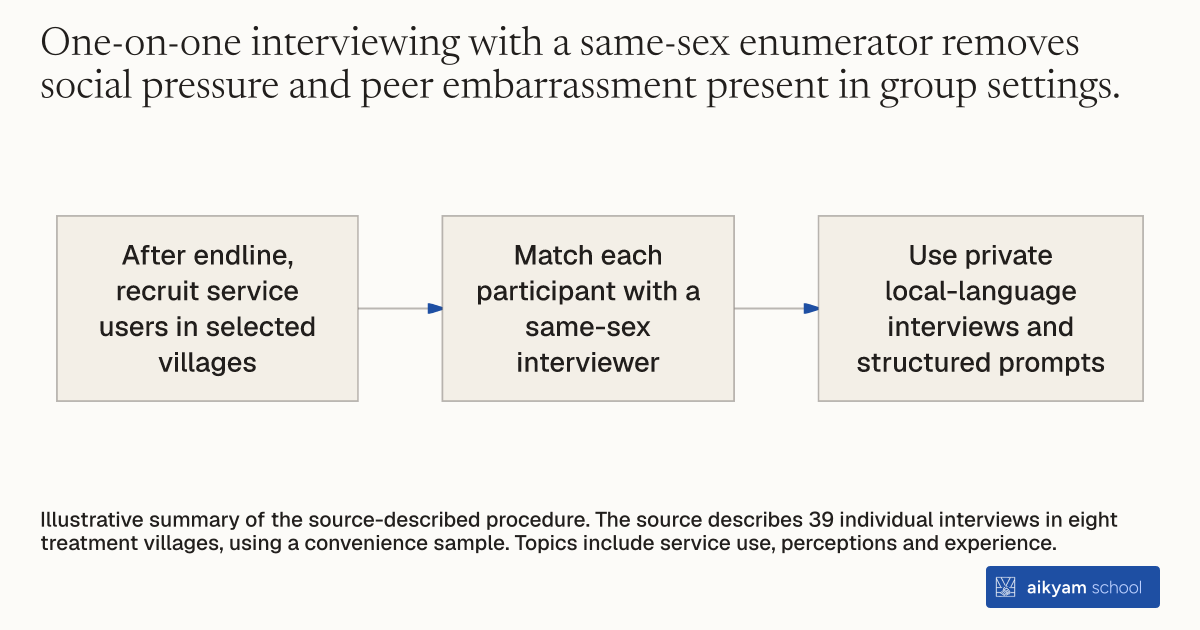
Interview service users privately
- After endline, recruit service users in selected villages
- Match each participant with a same-sex interviewer
- Use private local-language interviews and structured prompts
Illustrative summary of the source-described procedure. The source describes 39 individual interviews in eight treatment villages, using a convenience sample. Topics include service use, perceptions and experience.
See source →How
When to use
Quantitative field evaluations can uncover surprising behavioral trends without revealing individual choices or motivations. Research on sensitive sexual health topics requires private one-on-one settings where respondents speak candidly. This method conducts private individual in-depth interviews matched by interviewer gender to collect detailed qualitative accounts.
Conduct individual in-depth interviews using same-sex interviewers in the local language following quantitative survey completion.
- Research managers select study communities for qualitative follow-up following endline survey completion.
- Field staff recruit a convenience sample of service users across selected target villages.
- Facilitators assign each selected participant to an individual interviewer of their own sex.
- Interviewers conduct private, one-on-one sessions in the local language at a confidential location.
- Interviewers guide open discussions using structured protocols covering service perception, usage, knowledge shifts, and user experience.
Why it works
Private interviews allow users to discuss personal experiences, technical frustration, and sensitive health choices in depth.
Example
Researchers conducted 39 individual in-depth interviews with service users across eight treatment villages in central Uganda using same-sex enumerators in the local language following the endline survey.
About the study
Participants
39 individual service users across eight randomly selected treatment villages in Masaka, Mpigi, Mityana, and Mubende districts in central Uganda.
Study Design
Qualitative evaluation using 39 single-sex individual in-depth interviews conducted in the local language by same-sex enumerators after endline survey collection.
Results
Qualitative interviews revealed key reasons for service drop-off, including lack of reminder messages, confusing search results in Luganda, transportation costs, and partner power dynamics where men sought outside sex when women refused.