Try, learn and adjust
Check deliberation in police training scenarios
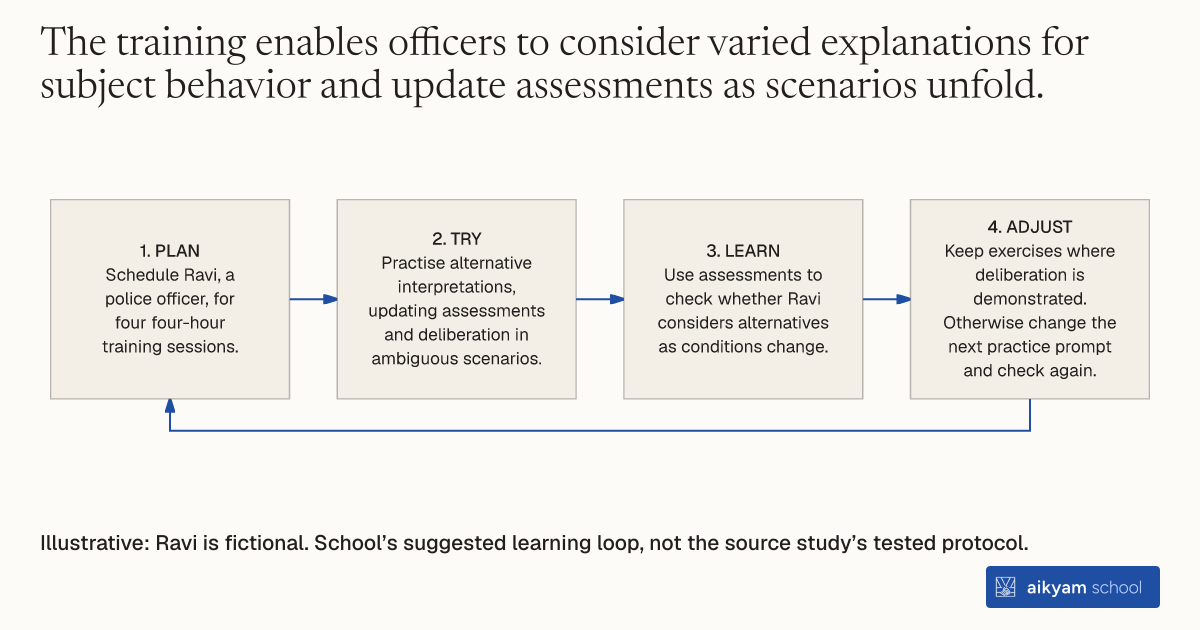
- Plan: Schedule Ravi, a police officer, for four four-hour training sessions.
- Try: Practise alternative interpretations, updating assessments and deliberation in ambiguous scenarios.
- Learn: Use assessments to check whether Ravi considers alternatives as conditions change.
- Adjust: Keep exercises where deliberation is demonstrated. Otherwise change the next practice prompt and check again.
Illustrative: Ravi is fictional. School’s suggested learning loop, not the source study’s tested protocol.
See source →School’s suggested learning loop, not the source’s tested procedure. Observe scenario assessments. This suggested practice loop does not establish field effects on force or arrests.
How
When to use
Police officers face ambiguous, high-stress situations during daily patrols. Fast default assumptions and cognitive biases in these encounters lead to unnecessary force and low-value discretionary arrests. Deliver situational decision-making training to officers to improve systematic thinking and reduce violent outcomes.
Train police officers using four four-hour sessions on situational decision-making to mitigate cognitive biases in ambiguous situations.
- Facilitators deliver four four-hour training sessions drawing on behavioral science and cognitive behavioral principles to police officers.
- Instructors train officers to improve deliberation by rapidly considering alternative interpretations of subject behavior.
- Facilitators guide officers through assessments to practice updating situational assessments as conditions change.
- Officers apply systematic deliberation in ambiguous, high-stress scenarios to rely less on default assumptions.
Why it works
Relying less on default assumptions improves deliberation and reduces use of nonlethal force during high-stress interactions.
Example
Instructors implemented the Situational Decision-Making training with officers at the Chicago Police Department across four four-hour sessions at US$807 to US$864 per officer. Trained officers reduced nonlethal force use and discretionary arrests by 23 percent, and reduced arrests of Black civilians by 11 percent.
About the study
Participants
Police officers at the Chicago Police Department.
Study Design
Randomized controlled trial and lab assessments measuring use of force, discretionary arrests, civilian demographics, and cognitive deliberative responses.
Results
Reduced nonlethal force and discretionary arrests by 23 percent, reduced arrests of Black civilians by 11 percent without lowering other arrest rates, and generated personnel cost savings from fewer officer injuries that outweighed training costs.