Try, learn and adjust
Check that financial goals have practical steps
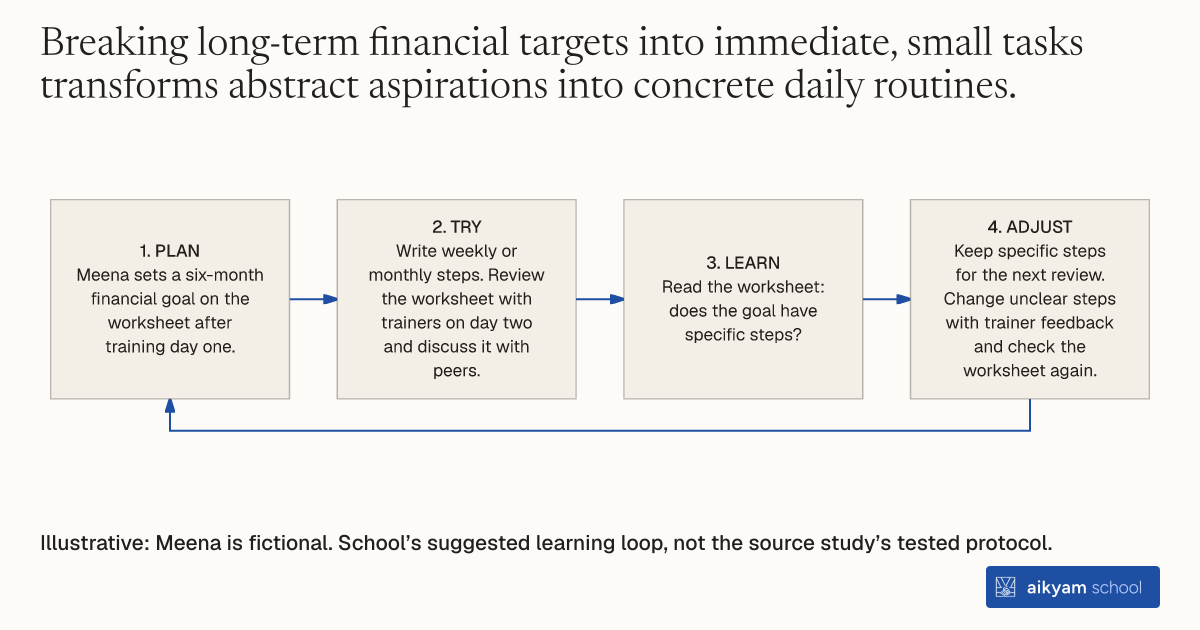
- Plan: Meena sets a six-month financial goal on the worksheet after training day one.
- Try: Write weekly or monthly steps. Review the worksheet with trainers on day two and discuss it with peers.
- Learn: Read the worksheet: does the goal have specific steps?
- Adjust: Keep specific steps for the next review. Change unclear steps with trainer feedback and check the worksheet again.
Illustrative: Meena is fictional. School’s suggested learning loop, not the source study’s tested protocol.
See source →Observe the six-month goal and written steps. School suggests this learning loop; it is not the source’s tested procedure.
How
When to use
Female micro-entrepreneurs in traditional settings often operate without structured financial plans or long-term growth targets. Without explicit goal setting, business decisions remain reactive and short-term. Assigning a structured goal decomposition worksheet as homework helps trainees define financial targets and break them down into actionable steps.
Assign a structured goal-setting worksheet as homework during training to guide trainees in decomposing financial targets into actionable steps.
- Distribute a goal-setting worksheet at the end of the first day of business training.
- Instruct trainees to set a personal or business financial target for the next six months.
- Guide trainees to write down the exact weekly or monthly steps needed to reach that target.
- Have trainers review the completed homework worksheets with trainees on the second day of training.
- Facilitate group feedback sessions where trainees share their financial goals and discuss execution strategies with peers.
Why it works
Discussing the homework with family members also fosters intra-household dialogue and support for business investments.
Example
In Ahmedabad, India, researchers assigned a six-month goal decomposition worksheet to 289 female microfinance clients during a two-day business course, which led upper-caste Hindu trainees to increase business discussions with family members by 17 percentage points.
About the study
Participants
N = 597 female microfinance clients (346 Upper Caste, 70 Scheduled Caste, 181 Muslim) aged 18 to 50 in Ahmedabad, India.
Study Design
Randomized Controlled Trial evaluating 289 treated women across 57 two-day training session clusters using instrumental variables four months post-training.
Results
Completing the goal decomposition module contributed to a 17 percentage point increase in business discussions with family (p < 0.05) and a 19 percentage point increase in labor market participation (p < 0.01) among upper-caste Hindu women.