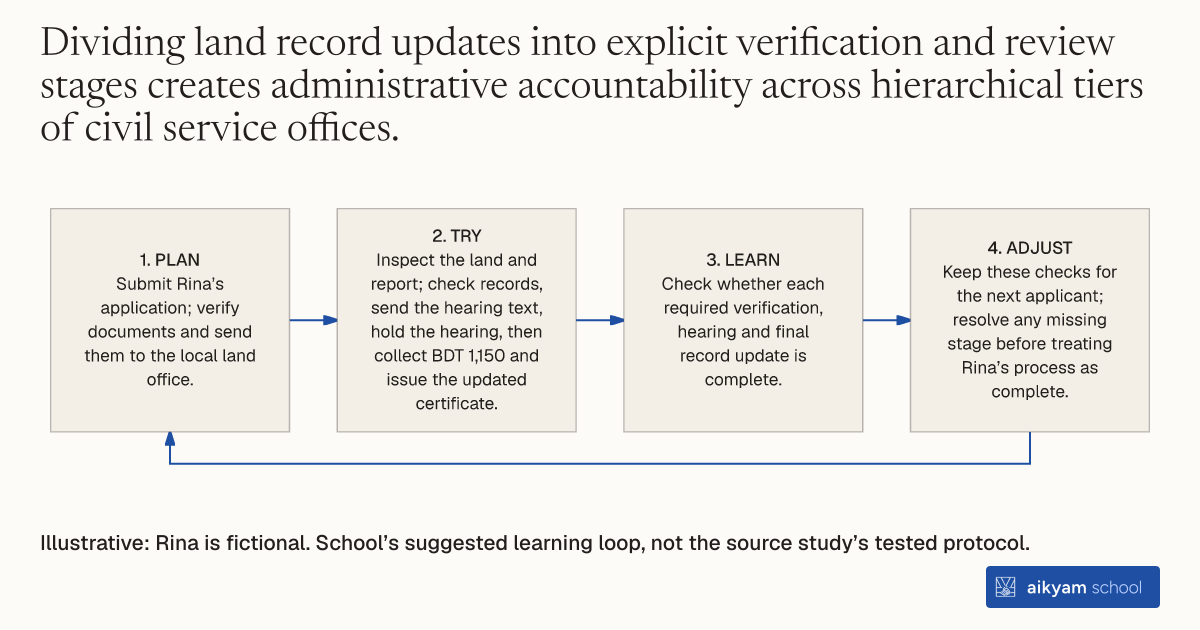
Try, learn and adjust
Check the land record process is complete
- Plan: Submit Rina’s application; verify documents and send them to the local land office.
- Try: Inspect the land and report; check records, send the hearing text, hold the hearing, then collect BDT 1,150 and issue the updated certificate.
- Learn: Check whether each required verification, hearing and final record update is complete.
- Adjust: Keep these checks for the next applicant; resolve any missing stage before treating Rina’s process as complete.
Illustrative: Rina is fictional. School’s suggested learning loop, not the source study’s tested protocol.
See source →Observe the six administrative stages, fee and certificate; Rina need not repeat the application. School suggests this learning loop; it was not tested by the source.
How
When to use
When land changes ownership through sale or inheritance, official land ownership records must be updated to maintain secure property rights. Cumbersome procedures cause property buyers to delay registering land record changes until legal disputes occur. This method establishes a standardized legal process for processing and approving land record mutation applications.
Process land record mutation applications through a structured six-step administrative procedure managed across subdistrict and local land offices.
- Submit an application for a land record change online or at the subdistrict land office.
- Verify application documents at the subdistrict land office and send the application to the local Union Parishad land office.
- Inspect the land, meet the applicant, and submit a verification report from the Union Land Office Assistant to the subdistrict land office.
- Check the report against government land records at the subdistrict land office and issue a hearing summons to the applicant via text message.
- Hold a formal application review hearing between the applicant and the Assistant Commissioner Land at the subdistrict office.
- Collect the official BDT 1,150 fee from the applicant, update the government land registry, and issue the new record of rights khatian certificate.
Why it works
Standardizing fee payments and hearing requirements clarifies formal obligations for both civil servants and applicants.
Example
In Bangladesh, 311 subdistrict land offices implemented the six-step land mutation process to update land record of rights certificates for 1,034,688 applications.
About the study
Participants
311 subdistrict land offices in Bangladesh serving approximately 97 million people, tracking 1,034,688 applications.
Study Design
Field experiment measuring application processing times across subdistrict land offices under standard and scorecard-monitored implementations of the six-step process.
Results
In the baseline control group, 56% of applications were completed within the 45-working-day limit with an average processing duration of 64 working days; introducing scorecards improved on-time completion by 6 percentage points and reduced processing duration by 13%.