Research sample
Check six weeks of benefit records
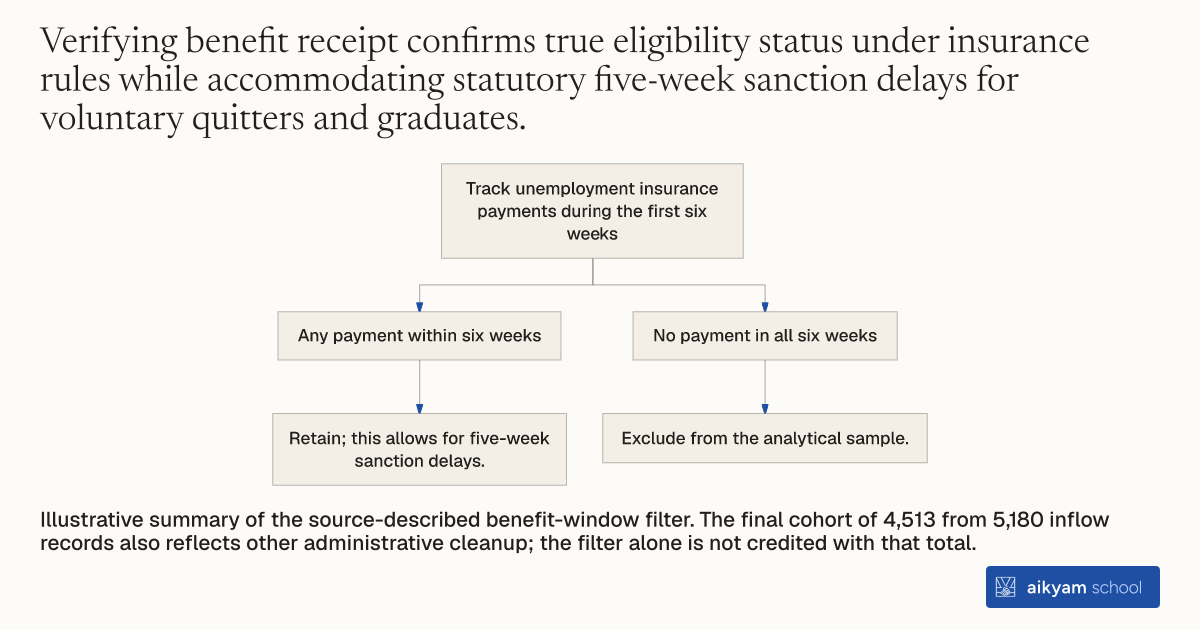
Track unemployment insurance payments during the first six weeks
- Any payment within six weeks
- Retain; this allows for five-week sanction delays.
- No payment in all six weeks
- Exclude from the analytical sample.
Illustrative summary of the source-described benefit-window filter. The final cohort of 4,513 from 5,180 inflow records also reflects other administrative cleanup; the filter alone is not credited with that total.
See source →How
When to use
Administrative job center registers often include individuals who do not qualify for targeted insurance program rules or who experience temporary benefit sanctions. Filtering sample data using a six-week benefit observation window cleans the trial cohort by retaining legitimate benefit recipients while accommodating initial sanction delays. Evaluators use this screening rule when preparing administrative unemployment data for policy experiments.
Filter raw administrative registry records by requiring benefit receipt within an initial six-week window.
- Extract inflow records for all individuals registered as entering open unemployment.
- Track weekly public benefit transfer payments for each registered person across their first six weeks.
- Retain individuals who receive unemployment insurance benefit payments at any point during the six-week window.
- Include workers subject to standard five-week sanction delays, such as recent graduates or voluntary quitters.
- Exclude individuals who receive zero unemployment insurance payments across all six weeks due to misclassification or non-eligibility.
Example
Researchers cleaned an initial inflow sample of 5,180 registered unemployed individuals across Storstrøm and Southern Jutland counties between late 2005 and early 2006. Applying the six-week benefit window filter alongside minor administrative cleanup steps removed 12% of records in Storstrøm and 15% in Southern Jutland, producing a final analytical cohort of 4,513 participants without introducing treatment group imbalance.
About the study
Participants
N = 5,180 initial inflow individuals filtered to N = 4,513 unemployed workers across Storstrøm and Southern Jutland counties, Denmark.
Study Design
Four-step sample selection protocol applying a six-week benefit receipt observation window to administrative trial register data.
Results
The filtering method removed 12% of cases in Storstrøm and 15% in Southern Jutland without causing systematic differences between treatment and control group proportions, establishing a balanced experimental cohort of 4,513 individuals.