Research budget analysis
Estimate net government budget gains
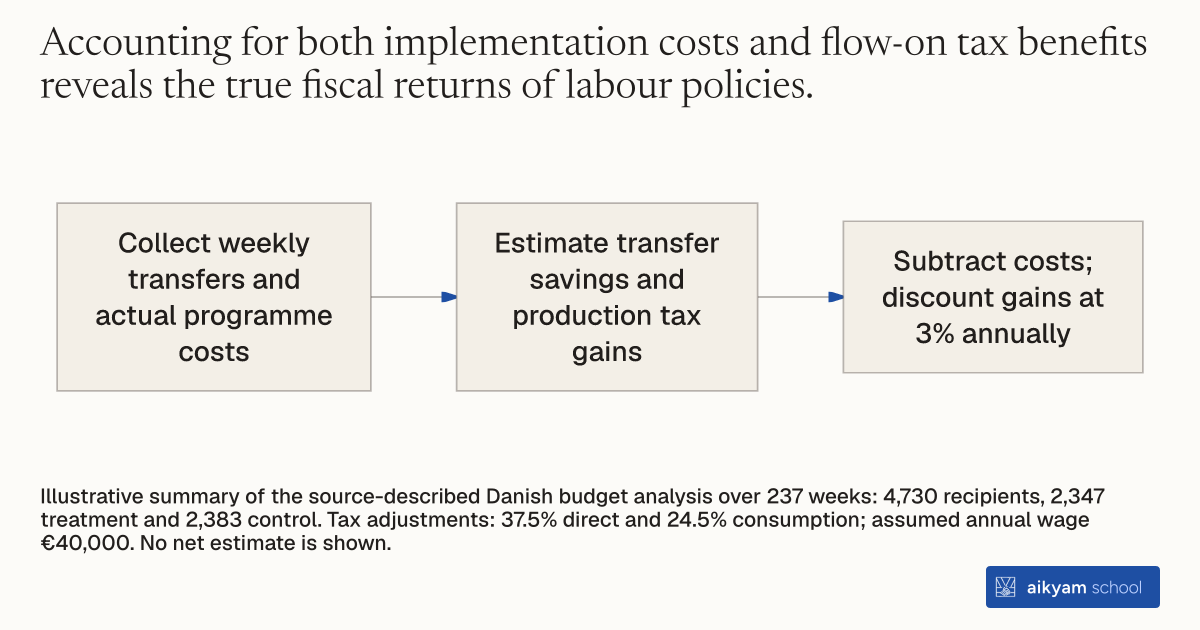
- Collect weekly transfers and actual programme costs
- Estimate transfer savings and production tax gains
- Subtract costs; discount gains at 3% annually
Illustrative summary of the source-described Danish budget analysis over 237 weeks: 4,730 recipients, 2,347 treatment and 2,383 control. Tax adjustments: 37.5% direct and 24.5% consumption; assumed annual wage €40,000. No net estimate is shown.
See source →How
When to use
Governments spend significant public funds on active labour market policies to reduce unemployment, but evaluations often ignore actual operational costs and fiscal returns. Policy makers need an empirical framework to calculate the net fiscal impact of active labour market interventions on state finances. Evaluating saved social transfers alongside tax revenue from increased production allows governments to identify cost-effective employment programmes.
Calculate the net government budget impact of active labour market programmes by tracking participant transfer savings, tax revenues, and programme implementation costs over time.
- Evaluators obtain detailed administrative register data on weekly public income transfers paid to treatment and control group individuals.
- Analysts calculate direct caseworker and programme operational costs based on meeting duration, group size, and actual staff wage rates.
- Economists measure saved income transfers between treatment and control groups over 237 weeks, adjusting for direct income taxes (37.5 percent) and indirect consumption taxes (24.5 percent).
- Evaluators estimate the value of increased economic production using an annual worker wage of 40,000 euros and apply the tax yield rate to calculate net public revenue.
- Researchers combine tax gains from increased production with adjusted transfer savings, subtract total programme operating costs, and discount net gains at a 3 percent annual rate.
Why it works
Intensive counselling interventions shorten unemployment spells, generating tax revenues from employment that exceed initial operational costs.
Example
Evaluating three Danish randomized social experiments with 4,730 unemployed benefit recipients over 237 weeks showed that fortnightly individual caseworker meetings generated a net discounted budget improvement of 4,457 euros per unemployed worker, while group meetings and early activation yielded non-significant budget gains of 2,539 euros and 1,392 euros respectively.
About the study
Participants
4,730 Danish unemployment insurance recipients (2,347 treatment, 2,383 control) across three regional randomized trials.
Study Design
Randomized social experiment combining administrative register data with detailed programme cost data to calculate net discounted budget impacts using a 3 percent annual discount rate and bootstrapped confidence intervals.
Results
Individual meetings yielded a net discounted budget benefit of 4,457 euros per worker (95% CI: 486 to 8,215 euros), driven by 3,631 euros in saved transfers and 3,438 euros in production tax gains offset by 47 euros in net programme costs.