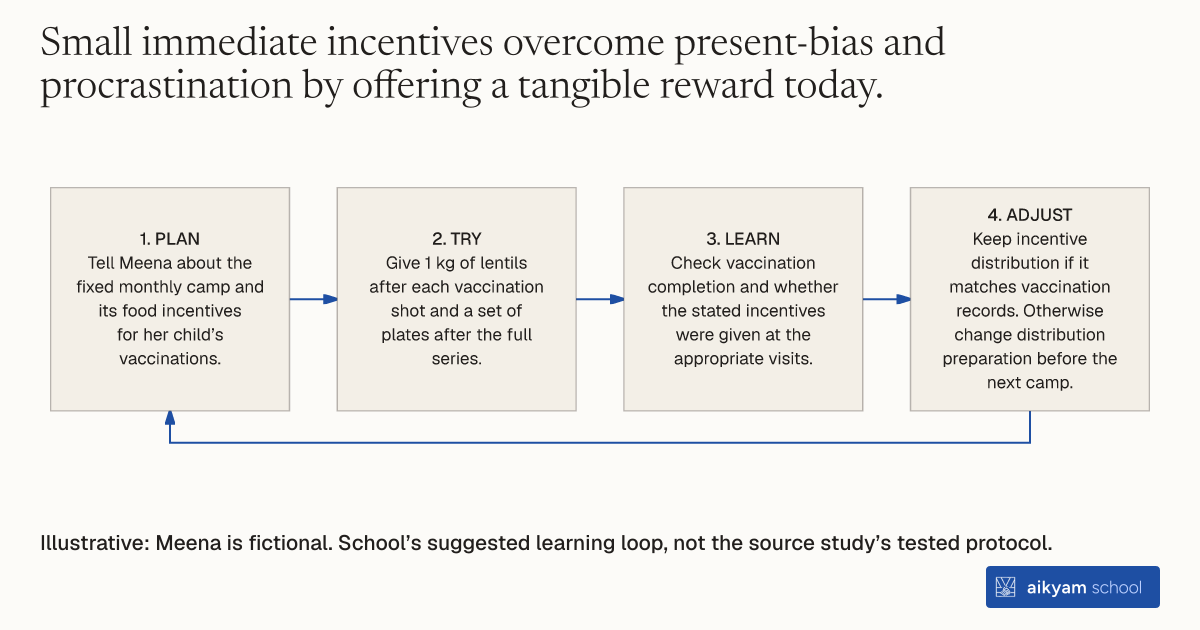
Try, learn and adjust
Check food incentives follow vaccination visits
- Plan: Tell Meena about the fixed monthly camp and its food incentives for her child’s vaccinations.
- Try: Give 1 kg of lentils after each vaccination shot and a set of plates after the full series.
- Learn: Check vaccination completion and whether the stated incentives were given at the appropriate visits.
- Adjust: Keep incentive distribution if it matches vaccination records. Otherwise change distribution preparation before the next camp.
Illustrative: Meena is fictional. School’s suggested learning loop, not the source study’s tested protocol.
See source →School’s suggested learning loop: observe vaccine completion and incentive delivery; the check is not a separate test of effectiveness.
How
When to use
Parents in rural communities often delay or drop out of multi-dose child immunization schedules due to procrastination or weak beliefs in preventive care. Offering a small, immediate food reward at each vaccination session gives parents an instant reason to act. This method helps health organizations increase complete vaccination rates among poor households.
Provide small non-cash food incentives to parents at each child immunization visit to ensure complete vaccination.
- NGO administrators schedule monthly mobile immunization camps on fixed dates in target rural villages.
- Local health workers inform village parents about the camp date and the available food incentive.
- Health staff administer the required vaccine dose to each arriving child.
- Camp staff give 1 kg of lentils to the parent immediately after each vaccination shot.
- Camp staff present a set of plates to the parent upon the child completing the full immunization series.
Why it works
Higher attendance keeps field health workers busy, which spreads fixed transport and staffing costs across more children and lowers overall program costs.
Example
Seva Mandir distributed 1 kg of lentils per vaccination and a set of plates upon full completion across rural villages in Udaipur, Rajasthan. Full child immunization rates rose to 39% compared to 18% in villages with reliable service alone, while delivery costs dropped from $56 to $28 per fully immunized child.
About the study
Participants
Poor tribal households with children aged 1 to 3 years across rural villages in Udaipur district, Rajasthan, India.
Study Design
A clustered randomized controlled trial comparing three groups: comparison villages, reliable service villages, and reliable service plus non-cash incentives villages.
Results
Full immunization rates among children aged 1 to 3 climbed to 39% in incentive villages compared to 18% with reliable camps alone and 6% in comparison villages, halving the cost per child fully immunized from $56 to $28.