Research survey
Validate childhood vaccination reports
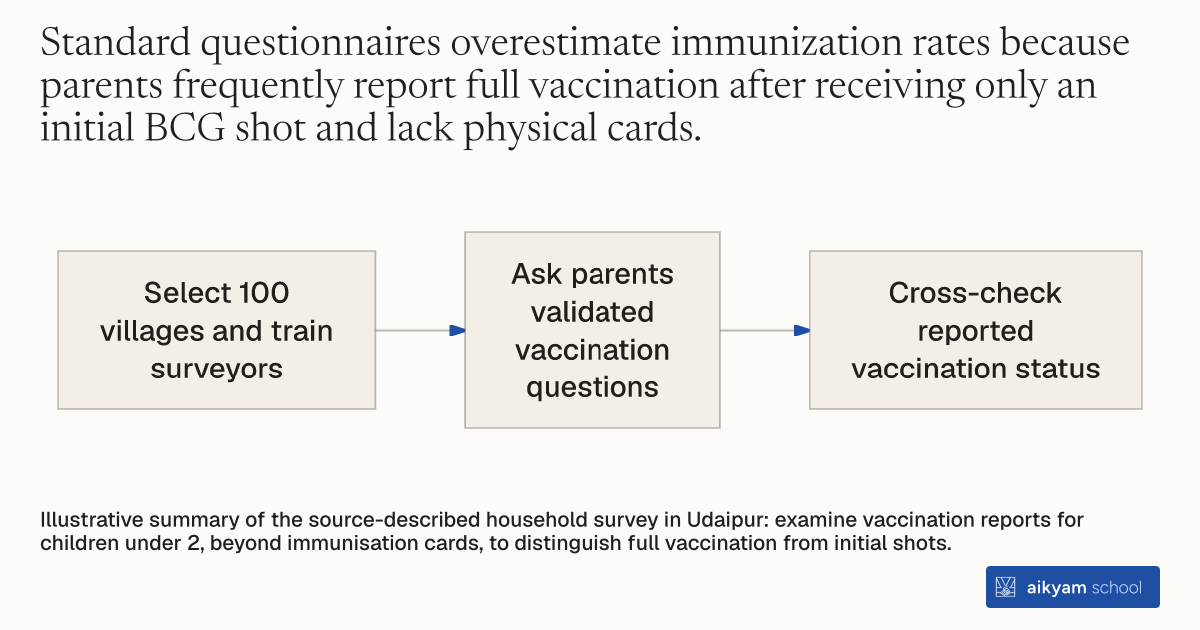
- Select 100 villages and train surveyors
- Ask parents validated vaccination questions
- Cross-check reported vaccination status
Illustrative summary of the source-described household survey in Udaipur: examine vaccination reports for children under 2, beyond immunisation cards, to distinguish full vaccination from initial shots.
See source →How
When to use
Public health agencies in developing regions often lack reliable data on child immunization rates because official statistics and unvalidated parental reports overestimate actual coverage. Conducting a direct, validated survey reveals the real extent of non-vaccination in rural communities. This method helps program directors identify true baseline immunization levels for children under two years old.
Conduct a validated household survey across target villages to measure accurate child immunization rates.
- Partner with a local non-governmental organization working directly with rural populations.
- Select 100 representative villages in the rural target district.
- Train survey enumerators to visit households with young children.
- Administer a validated health questionnaire to parents regarding their children's vaccination status.
- Cross-check parental claims beyond immunization cards to verify whether children received full vaccination or only initial shots like BCG.
Why it works
A validated survey corrects for parental recall bias and identifies systemic failures in preventive healthcare delivery.
Example
Researchers surveyed parents in 100 rural villages in Udaipur, Rajasthan, and found that true full immunization was below 2% according to the validated survey, compared to 16% reported in standard parental surveys and 22% in official regional statistics.
About the study
Participants
100 villages in Udaipur district, Rajasthan, India, studying poor tribal households with children under 2 years old.
Study Design
A detailed baseline health-seeking behavior and immunization survey using a validated questionnaire, comparing results with standard survey responses and official demographic data.
Results
The validated survey found the true baseline child immunization rate was below 2%, whereas standard questionnaires reported 16% and official surveys reported 22%.