Try, learn and adjust
Use stories without prescribing community choices
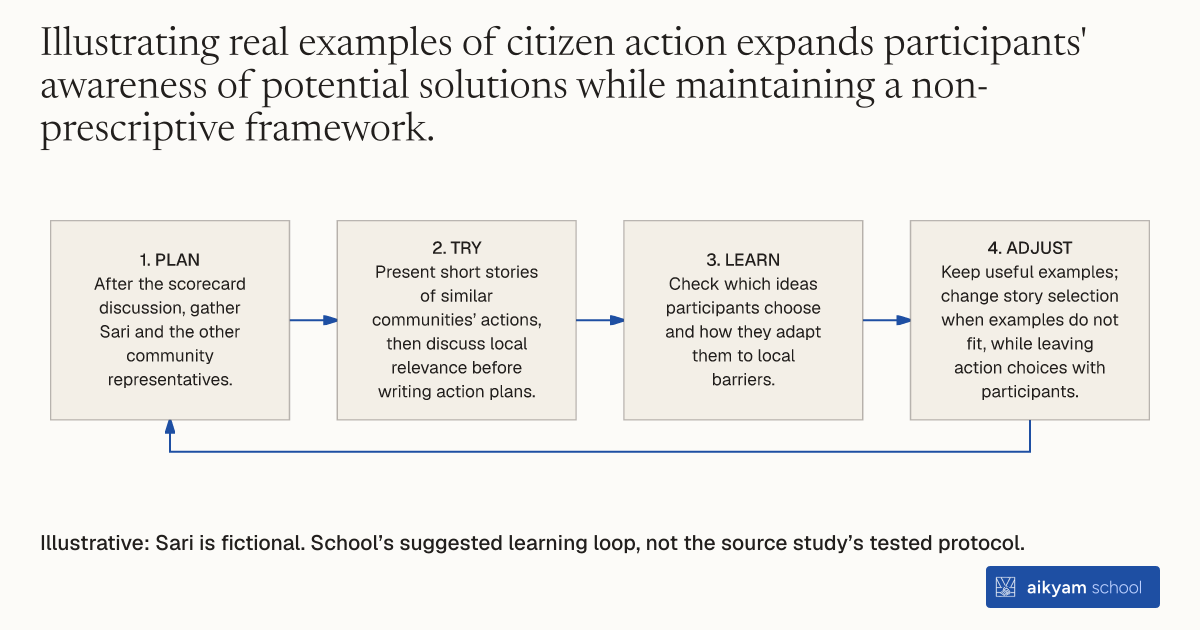
- Plan: After the scorecard discussion, gather Sari and the other community representatives.
- Try: Present short stories of similar communities’ actions, then discuss local relevance before writing action plans.
- Learn: Check which ideas participants choose and how they adapt them to local barriers.
- Adjust: Keep useful examples; change story selection when examples do not fit, while leaving action choices with participants.
Illustrative: Sari is fictional. School’s suggested learning loop, not the source study’s tested protocol.
See source →Observe discussion and community-selected plans; do not attribute the whole programme’s action totals to stories alone. School suggests this learning loop; it was not tested by the source.
How
When to use
Rural citizens participating in civic deliberation meetings often need inspiration and concrete ideas for local problem-solving. Facilitators deploy short stories of successful community actions from similar contexts to broaden citizen thinking. This method helps community representatives see possibilities for action without prescribing specific solutions.
Present short social action stories to community representatives during the initial deliberative planning process.
- Select vignettes depicting actions that similar communities took to improve public service delivery or uptake.
- Convene 15 to 16 recruited community representatives in each village following the scorecard discussion.
- Present each short story vignette to the group to demonstrate how other citizens solved specific service breakdowns.
- Facilitate a discussion on the presented stories to explore which approaches adapt well to local village challenges.
- Guide community representatives to transition into formulating their own non-prescriptive social action plans.
Why it works
Hearing how peer communities tackled similar obstacles inspires citizens and demonstrates that local action is achievable.
Example
In 200 treatment villages across Indonesia and Tanzania, facilitators presented social action story vignettes—such as stories featuring facility suggestion boxes or media engagement—to community representatives. These story presentations inspired participants across the 200 villages to design 1,139 local social actions across 43 distinct goal categories.
About the study
Participants
200 rural villages across two regions in Indonesia and two regions in Tanzania, involving 15 to 16 community representatives per village.
Study Design
Randomized controlled trial evaluation of a non-prescriptive civic deliberation intervention, measuring how presenting social action vignettes during planning meetings affected the diversity and completion of community-designed action plans.
Results
Following vignette presentations, community representatives in 200 villages designed 1,139 social actions (5.5 per village average), with 57.6% (655 actions) completed within 90 days and 90.9% utilizing collaborative strategies.