Try, learn and adjust
Review locally chosen maternal health actions
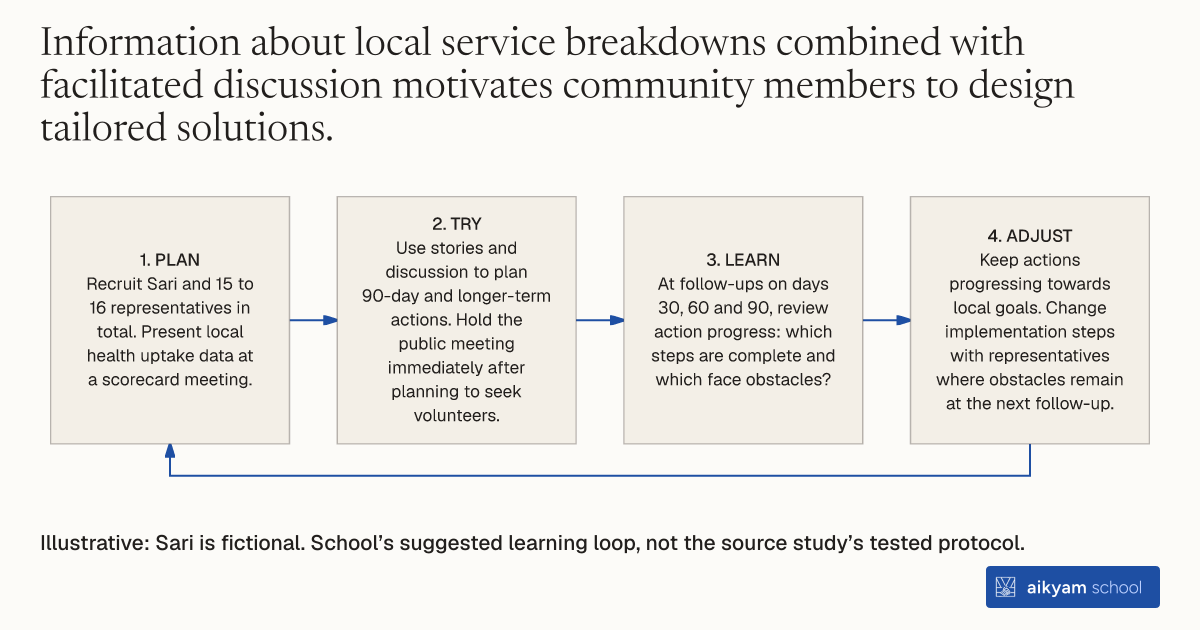
- Plan: Recruit Sari and 15 to 16 representatives in total. Present local health uptake data at a scorecard meeting.
- Try: Use stories and discussion to plan 90-day and longer-term actions. Hold the public meeting immediately after planning to seek volunteers.
- Learn: At follow-ups on days 30, 60 and 90, review action progress: which steps are complete and which face obstacles?
- Adjust: Keep actions progressing towards local goals. Change implementation steps with representatives where obstacles remain at the next follow-up.
Illustrative: Sari is fictional. School’s suggested learning loop, not the source study’s tested protocol.
See source →School's suggested, untested loop: observe local plans, progress and obstacles; this loop does not establish health effects of the programme.
How
When to use
Rural communities face poor maternal and newborn health care quality and low service uptake. Local citizens need non-prescriptive deliberative spaces to identify health service breakdowns and design local solutions. Program organizers deploy this method to enable community members to formulate and execute their own health action plans.
Implement a multi-meeting civic deliberation and social action program to address local maternal and newborn health problems.
- Recruit 15 to 16 local citizens as community representatives or community activists in each participating village.
- Convene an initial Scorecard meeting where a local facilitator presents village health data on antenatal care, facility birth, and postnatal care uptake.
- Conduct a Social Action Planning meeting where facilitators present action story vignettes and guide community representatives to design 90-day and long-term social action plans.
- Hold an Open Public meeting immediately after planning to present designed actions to the wider village and recruit volunteers.
- Convene three monthly Follow-Up meetings at 30, 60, and 90 days to review progress, celebrate successes, and address implementation obstacles.
Why it works
Non-prescriptive planning allows citizens to choose actions that fit their specific village context and capabilities.
Example
In 200 rural villages across Indonesia and Tanzania, community representatives designed 1,139 social actions over three months. Participating communities designed between 2 and 17 actions each, and completed 655 actions by the 90-day follow-up meeting.
About the study
Participants
200 rural villages across two regions in Indonesia and two regions in Tanzania, engaging thousands of community members and 15 to 16 representatives per village.
Study Design
Two large-scale randomized controlled trials evaluated a three-month non-prescriptive civic deliberation program with six facilitated community meetings, collecting social action plans and key informant verification data across treatment villages.
Results
Participants designed 1,139 social actions (average of 5.5 per village), and reported 57.6% (655 actions) complete within 90 days, with 93.5% of villages designing education campaigns and 71.0% targeting facility access.