Try, learn and adjust
Check soft skill feedback informs job choices
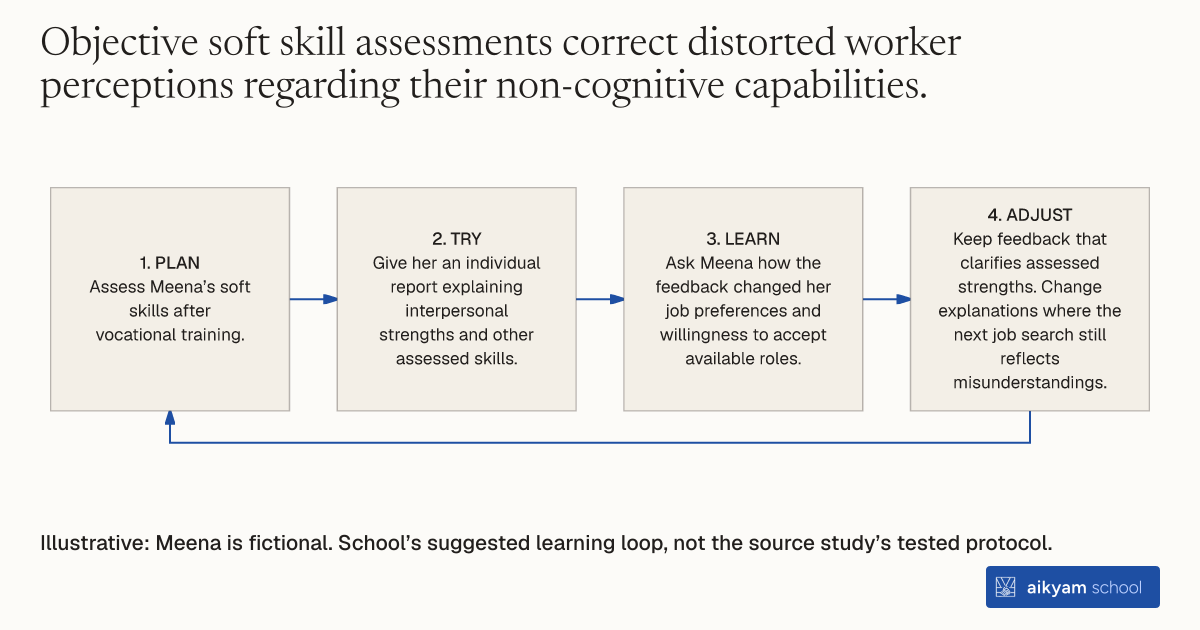
- Plan: Assess Meena’s soft skills after vocational training.
- Try: Give her an individual report explaining interpersonal strengths and other assessed skills.
- Learn: Ask Meena how the feedback changed her job preferences and willingness to accept available roles.
- Adjust: Keep feedback that clarifies assessed strengths. Change explanations where the next job search still reflects misunderstandings.
Illustrative: Meena is fictional. School’s suggested learning loop, not the source study’s tested protocol.
See source →School’s suggested, untested loop. Observe assessment feedback, preferences and applications. Employment effects were unclear; trainees became less willing to accept lower-quality jobs.
How
When to use
Job seekers completing vocational programs often lack objective data regarding their non-cognitive soft skills, leading to unrealistic job application expectations. Program managers struggle to guide trainees toward suitable employment opportunities without verified skill evaluations. This method provides candidates with objective soft skill feedback to align job search expectations with reality.
Assess vocational trainees on non-cognitive soft skills and deliver objective evaluation feedback to refine candidate job selection strategies.
- Program evaluators test vocational trainees on non-cognitive soft skills following course completion.
- Evaluators analyze test data to quantify individual strengths in interpersonal and non-cognitive domains.
- Agency staff provide trainees with individualized assessment reports detailing their soft skill profile.
- Trainees review soft skill diagnostic results to adjust their job preferences and target suitable employment positions.
Why it works
Accurate information helps trainees identify eligible employment tiers and avoid applying for ill-fitted roles.
Example
In urban areas of Uganda, participants in a vocational training program received soft skills feedback after taking an assessment through the BRAC Job Placement Program. Trainees shifted their expectations closer in line with reality regarding which jobs they could apply for, though they became less willing to accept lower-quality jobs.
About the study
Participants
Human vocational training participants in urban areas of Uganda.
Study Design
Randomized evaluation assessing soft skill testing and information feedback delivered via the BRAC Job Placement Program.
Results
Participants shifted expectations closer in line with reality about eligible job types, but overall employment impacts were unclear as trainees grew less willing to accept lower-quality jobs.