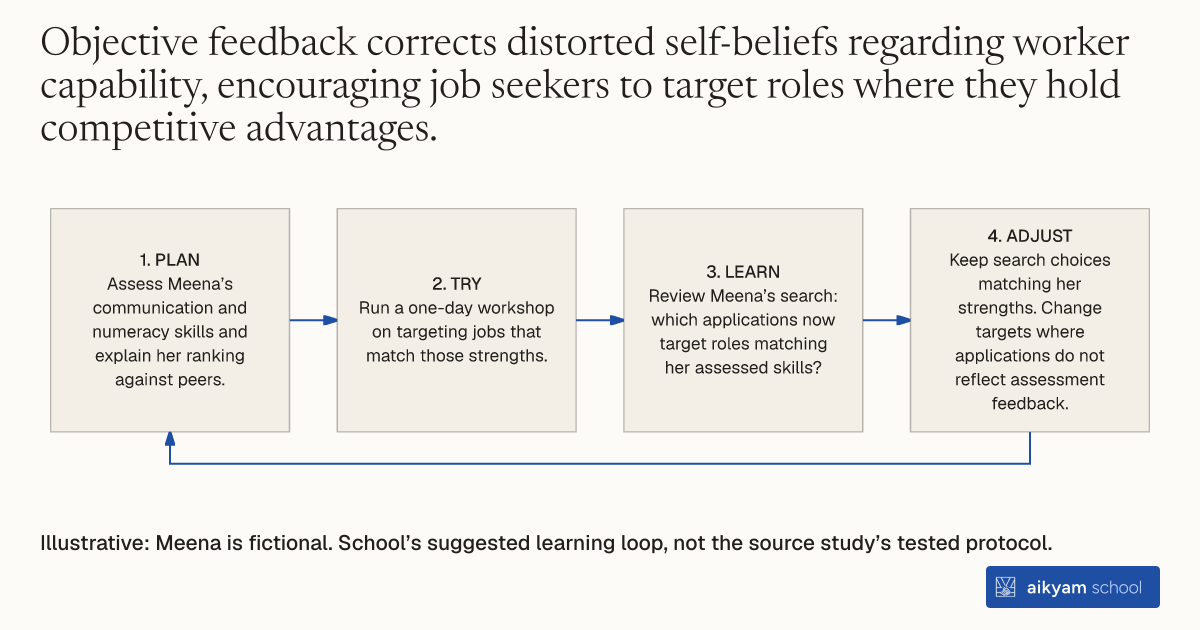
Try, learn and adjust
Check job searches reflect assessed strengths
- Plan: Assess Meena’s communication and numeracy skills and explain her ranking against peers.
- Try: Run a one-day workshop on targeting jobs that match those strengths.
- Learn: Review Meena’s search: which applications now target roles matching her assessed skills?
- Adjust: Keep search choices matching her strengths. Change targets where applications do not reflect assessment feedback.
Illustrative: Meena is fictional. School’s suggested learning loop, not the source study’s tested protocol.
See source →School’s suggested, untested loop. Observe feedback and search choices. The assessment and workshop were evaluated together; this loop does not establish employment effects.
How
When to use
Low-income young job seekers often lack accurate information about their relative communication and numeracy skills, leading to misdirected job search strategies. Uncalibrated expectations cause applicants to waste time applying for ill-fitted positions. This method helps job seekers align self-beliefs with objective skill levels and direct search efforts toward suitable sectors.
Deliver a standardized skill assessment combined with a search orientation workshop to guide job seekers toward skill-matched employment.
- Agency staff assess job seekers on core communication and numeracy skills using standardized tests.
- Evaluators score test results and provide candidates with objective feedback on their skill rankings relative to peers.
- Facilitators host a one-day workshop teaching candidates how to target open roles matching their specific skill strengths.
- Job seekers adjust their search intensity and redirect job applications toward industries where their skills are in demand.
Why it works
Directed search increases application efficiency and improves the likelihood of receiving aligned job offers.
Example
In Johannesburg, South Africa, a job search agency provided low-income young job seekers with communication and numeracy skill assessments coupled with a one-day search workshop. Participants updated their self-beliefs, shifted search efforts toward skills-aligned positions, and earned cumulatively 1.8 times the program's operating cost in three and a half months relative to a control group.
About the study
Participants
Young job seekers from low-income backgrounds in Johannesburg, South Africa.
Study Design
Randomized evaluation (RCT) comparing candidates receiving skill assessments and a one-day job search workshop against a control group receiving neither.
Results
Participants updated their skill beliefs, shifted search toward matching jobs, and earned 1.8 times the cost of running the program within three and a half months compared to the control group.