Try, learn and adjust
Check police training attendance and duty cover
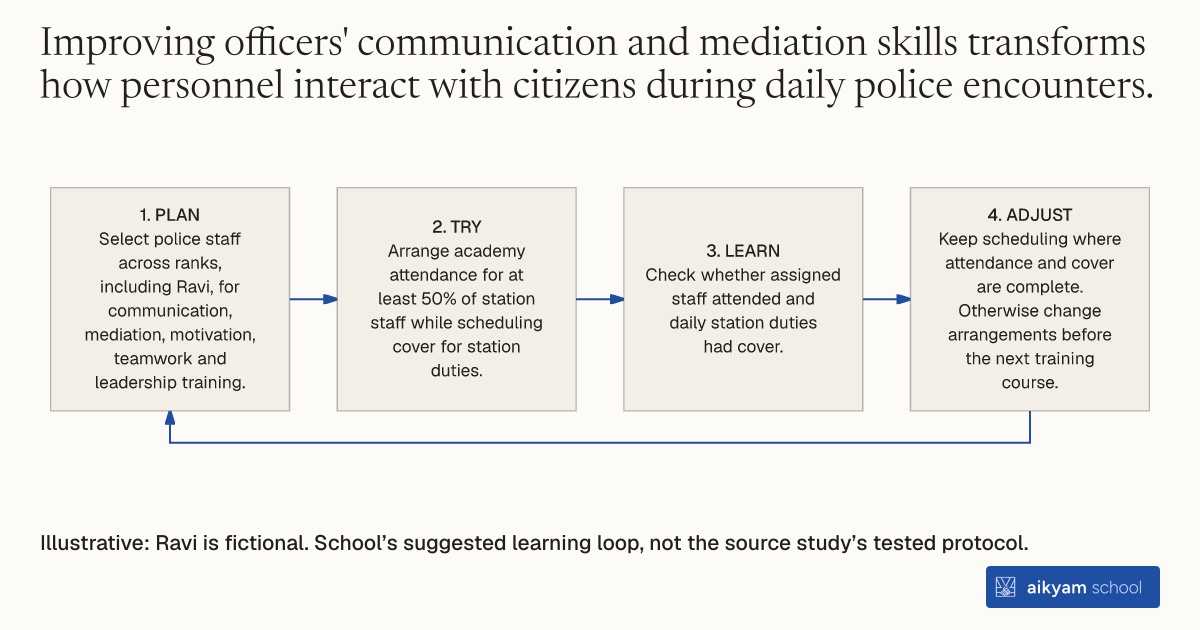
- Plan: Select police staff across ranks, including Ravi, for communication, mediation, motivation, teamwork and leadership training.
- Try: Arrange academy attendance for at least 50% of station staff while scheduling cover for station duties.
- Learn: Check whether assigned staff attended and daily station duties had cover.
- Adjust: Keep scheduling where attendance and cover are complete. Otherwise change arrangements before the next training course.
Illustrative: Ravi is fictional. School’s suggested learning loop, not the source study’s tested protocol.
See source →School’s suggested, untested loop: observe attendance and coverage. This delivery check does not establish effects on victim satisfaction.
How
When to use
Police departments suffer from citizen distrust, poor communication, and strained public relations. Personnel across ranks lack formal instruction in interpersonal communication, mediation, and team leadership. Police academies deliver soft skills training modules to improve officer behavior and build public trust.
Provide structured in-service soft skills training covering communication and leadership to police personnel at an academy.
- Police department leaders select officers and constables across ranks to attend academy soft skills courses.
- Police academy instructors prepare coursework covering communication, mediation, motivation, team building, and leadership.
- Department administrators assign at least fifty percent of station staff to complete the training course.
- Station supervisors manage daily station duty schedules while staff members attend academy sessions.
Why it works
Training a critical mass of station staff establishes positive behavioral norms that increase victim satisfaction.
Example
The Rajasthan Police in India trained 1,541 police personnel in soft skills at the Rajasthan Police Academy. Training fifty percent of station staff increased crime victim satisfaction by twenty percent, prompting the department to expand soft skills training to 100,000 officials by 2016.
About the study
Participants
162 police stations in 11 districts across Rajasthan, India, serving 70,767 police personnel and 5,895 households.
Study Design
A randomized controlled trial evaluated police stations assigned to send personnel to soft skills academy training against comparison stations using household surveys and case file reviews.
Results
Eighty-eight percent of selected officers attended training, and training 50 percent of station staff increased victim satisfaction by 20 percent (more than double the baseline average under 30 percent), leading to a statewide scale-up for 100,000 officials.