Research steps
Sample households from map grid points
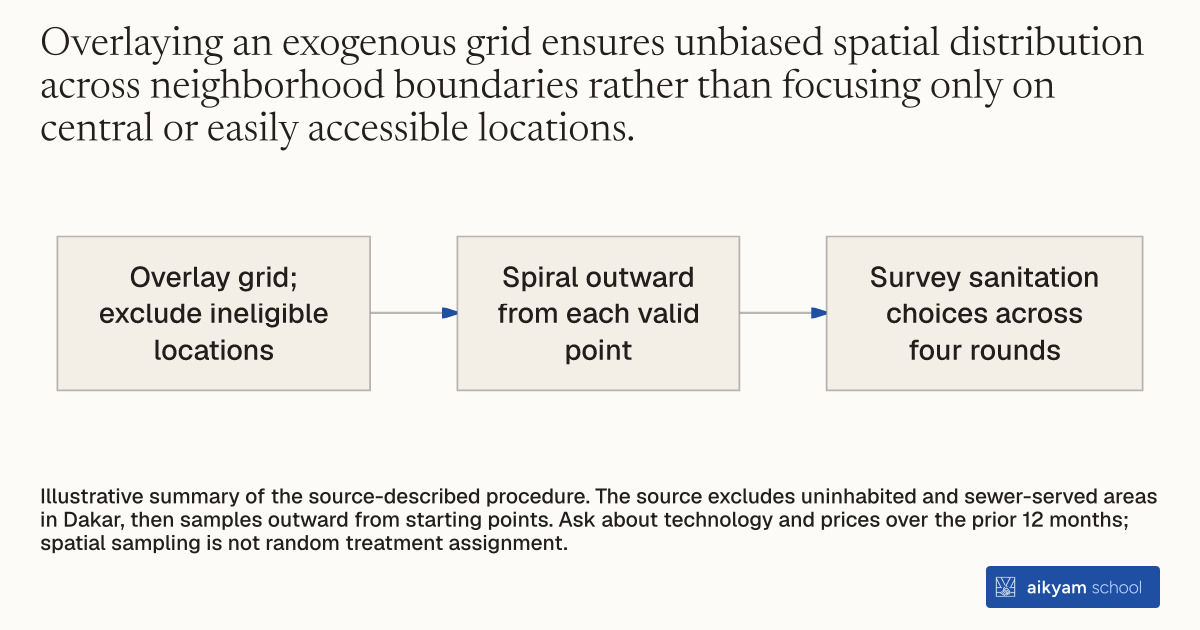
- Overlay grid; exclude ineligible locations
- Spiral outward from each valid point
- Survey sanitation choices across four rounds
Illustrative summary of the source-described procedure. The source excludes uninhabited and sewer-served areas in Dakar, then samples outward from starting points. Ask about technology and prices over the prior 12 months; spatial sampling is not random treatment assignment.
See source →How
When to use
Researchers need to measure household sanitation choices and transaction prices across an urban area without a complete population roster. The method addresses spatial selection bias and clustered sampling errors when assessing service access across administrative zones. It is designed for research teams studying decentralized infrastructure and household demand in urban developing country settings.
Select a representative sample of urban households across target neighborhoods using a geometric grid overlay and spiral sampling pattern.
- Survey designers overlay grid points across a map of the target metropolitan area.
- Survey designers exclude grid points located in uninhabited areas or zones served by the city sewer network.
- Enumerators navigate to each valid starting grid point on the map.
- Enumerators spiral outward from each starting point to select residential households.
- Enumerators collect survey data on household desludging technology choices and transaction prices paid over the previous 12 months across four survey rounds.
Why it works
Spiraling outward from designated points provides a structured sampling procedure that minimizes enumerator discretion while capturing local residential density.
Example
Researchers in Dakar, Senegal overlaid map grid points across seven residential arrondissements, excluded sewer-connected or uninhabited areas, and spiraled out from each point to sample households. This procedure built an unbalanced panel of 16,255 survey observations from 9,672 households, resulting in a final analytical sample of 9,970 transaction observations from 6,121 unique households.
About the study
Participants
16,255 survey observations from 9,672 households across seven residential arrondissements in Dakar, Senegal, yielding a final analytical sample of 9,970 transaction observations from 6,121 unique households.
Study Design
Four-round household panel survey employing spatial map grid overlays and outward spiraling from grid points to evaluate desludging choices and transaction prices.
Results
Mechanized desludging accounted for 50% of transactions with an average price of 22,800 CFA ($46) compared to 14,300 CFA ($24-$32) for manual baay pell services, while mechanized take-up reached 90% in Rufisque where average prices were 15,000 CFA compared to 40% take-up in the rest of Dakar.