Research procedure
Separate price and spouse assignment
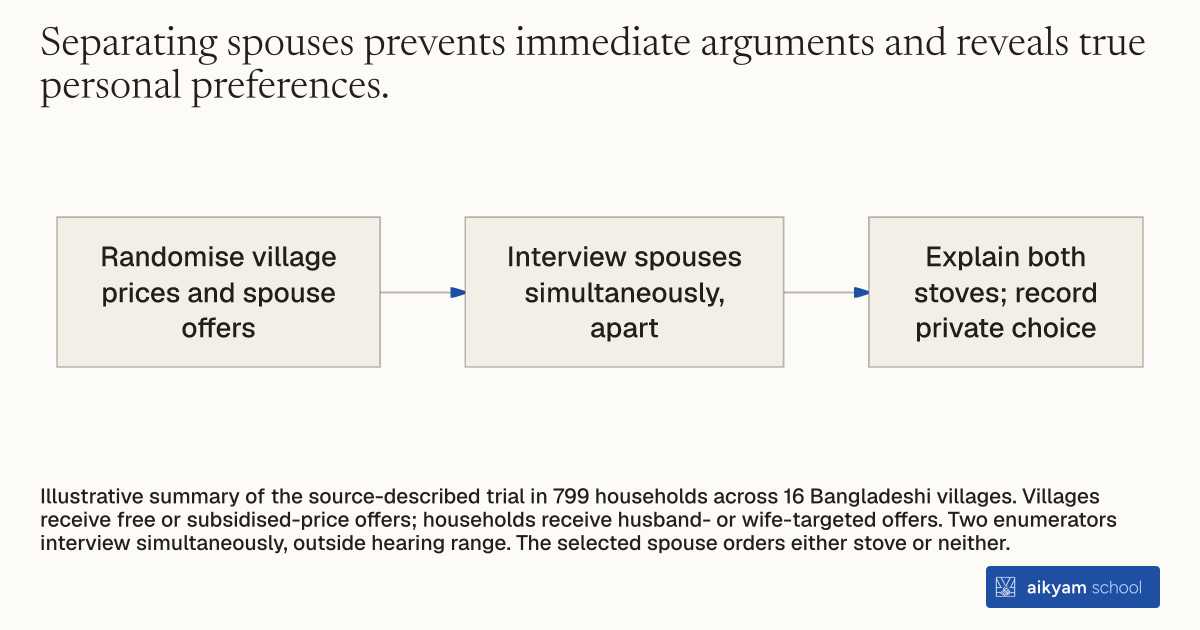
- Randomise village prices and spouse offers
- Interview spouses simultaneously, apart
- Explain both stoves; record private choice
Illustrative summary of the source-described trial in 799 households across 16 Bangladeshi villages. Villages receive free or subsidised-price offers; households receive husband- or wife-targeted offers. Two enumerators interview simultaneously, outside hearing range. The selected spouse orders either stove or neither.
See source →How
When to use
Rural households often reject new technologies because male financial decision-makers do not experience the cooking smoke that harms women. Program managers need to separate genuine user preferences from household spending constraints. This method offers health or fuel-saving products directly to husbands or wives in isolation at different price points.
Offer household technology options to individual spouses out of hearing range at randomized price points.
- Assign villages randomly to either a free stove treatment or a subsidized positive price treatment.
- Assign sample households randomly within each village to present the offer to either the husband or the wife.
- Send two enumerators to each household to interview both spouses at the same time.
- Separate the husband and wife so each interview takes place outside hearing range.
- Provide a standardized health education message and explain the features of both health-improving chimney stoves and budget-saving efficiency stoves.
- Allow the selected spouse to make an immediate individual order for a chimney stove, an efficiency stove, or no stove at the assigned price.
Why it works
Varying prices shows whether users with less spending power can act on their choices when products cost money.
Example
Researchers offered improved cookstoves to 799 married households in 16 villages across rural Bangladesh. When stoves were free, women ordered stoves at a 100% rate compared to 94% for men, preferring healthy chimney stoves 87% to 81%. When stoves required payment, female order rates dropped to 69% compared to 72% for men because women lacked money and spending authority.
About the study
Participants
799 rural married households across 16 villages in Jamalpur and Hatia districts of Bangladesh.
Study Design
Randomized controlled trial crossing gender of recipient (husband vs. wife) with stove price (free vs. subsidized) using simultaneous separate interviews out of hearing range.
Results
Free stoves led women to order at a 100% rate compared to 94% for men, with women 6.4 percentage points more likely to choose chimney stoves over efficiency stoves (87% vs 81%). Subsidized prices caused female orders to fall to 69% (versus 72% for men) and shifted women 15 percentage points away from expensive chimney stoves toward cheaper efficiency stoves compared to men (p=0.034).