Research procedure
Prepare automated health responses
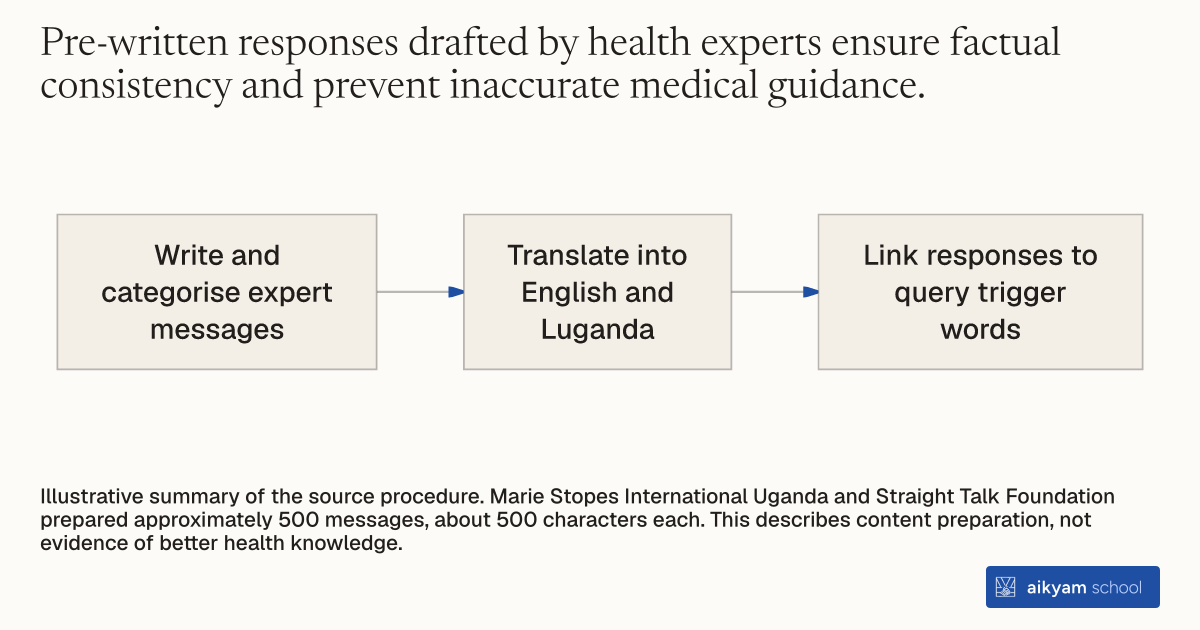
- Write and categorise expert messages
- Translate into English and Luganda
- Link responses to query trigger words
Illustrative summary of the source procedure. Marie Stopes International Uganda and Straight Talk Foundation prepared approximately 500 messages, about 500 characters each. This describes content preparation, not evidence of better health knowledge.
See source →How
When to use
Health education in low-resource settings often suffers from inconsistent messaging and unreliable information. Mobile advice tools require accurate, standardized medical answers that can be delivered automatically without real-time human clinical review. This method compiles a pre-verified database of concise health responses created by specialized non-governmental organizations.
Pre-compile and categorize a medical response database jointly through specialized health non-governmental organizations before launching automated mobile health messaging.
- Marie Stopes International Uganda and Straight Talk Foundation write approximately 500 unique factual health messages in simple language.
- NGO staff format each message to be about 500 characters long, including encouragements to use condoms or get tested for HIV.
- Content authors categorize entries into topic areas including HIV/AIDS, other STIs, maternal and neonatal health, body changes and sexuality, and family planning.
- Developers translate each response entry into English and Luganda to serve bilingual mobile users.
- System engineers link each database entry to specific trigger words for automated matching to incoming queries.
Why it works
Standardized text lengths fit mobile SMS constraints while delivering private and clear health information.
Example
Marie Stopes International Uganda and Straight Talk Foundation compiled 500 unique advice entries in English and Luganda across categories like body changes and sexuality (31%), HIV (10%), family planning (10%), and maternal and neonatal health (8%) for the 6001 SMS service in central Uganda.
About the study
Participants
2,424 adults aged 18 to 35 with at least six years of primary education in 60 villages across Masaka, Mpigi, Mityana, and Mubende districts in central Uganda.
Study Design
Clustered encouragement-design randomized trial in 60 villages with baseline and follow-up individual surveys, community surveys, and qualitative focus groups.
Results
The service led to no significant change in composite HIV knowledge (-0.0575 SD) or contraception knowledge (-0.0196 SD), but increased unfaithfulness from 12% to 27% and average partner count from 0.62 to 0.85.