Try, learn and adjust
Check broadcasts stay within the stated window
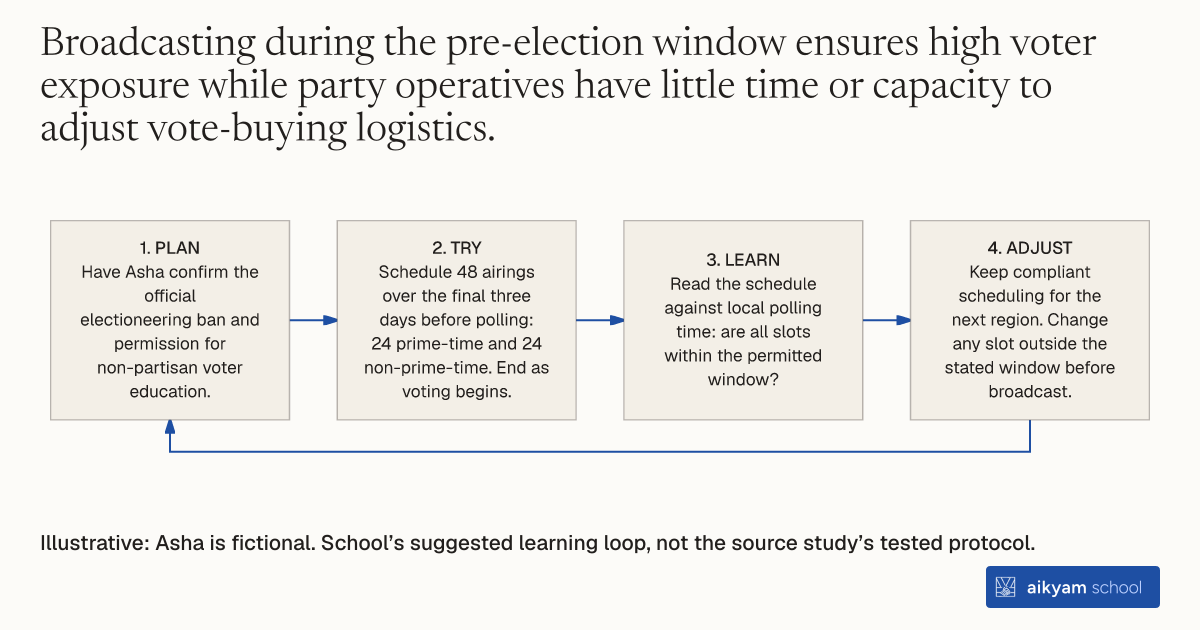
- Plan: Have Asha confirm the official electioneering ban and permission for non-partisan voter education.
- Try: Schedule 48 airings over the final three days before polling: 24 prime-time and 24 non-prime-time. End as voting begins.
- Learn: Read the schedule against local polling time: are all slots within the permitted window?
- Adjust: Keep compliant scheduling for the next region. Change any slot outside the stated window before broadcast.
Illustrative: Asha is fictional. School’s suggested learning loop, not the source study’s tested protocol.
See source →School’s suggested, untested loop: observe permissions, slot counts and local timing; this is not proof of persuasion or reduced party responses.
How
When to use
Political parties often alter campaign spending or increase voter surveillance when anti-corruption campaigns run early in an election cycle. Reaching voters without provoking counter-strategizing by candidates requires a restricted communication window. Campaigners can air non-partisan media during official electioneering bans when political parties can no longer easily adjust their vote-buying plans.
Time non-partisan civic media broadcasts to air exclusively within official pre-election silence periods to minimize strategic counter-responses from political candidates.
- Identify the legal pre-election window when official rules prohibit active party electioneering and campaigning.
- Confirm that public broadcast authority regulations permit non-partisan voter education ads during the electioneering ban.
- Schedule broadcasts to air across the final 3 days immediately preceding local polling day.
- Distribute broadcasts across 48 total airings over the 3-day window, splitting them into 24 prime-time and 24 non-prime-time slots.
- End broadcast schedules on polling day in each target region as local voting begins.
Why it works
This timing isolates the direct effect on voter attitudes from confounding changes in candidate campaigning behavior.
Example
Campaigners aired 60-second non-partisan ads over 3 days across 30 treated radio stations during the 2014 Indian general elections. Broadcasting during the official 3-day electioneering ban reduced the vote share of vote-buying parties by 3.5 to 7.1 percentage points without inducing changes in party canvassing or gift distribution.
About the study
Participants
The study covered 615 assembly constituencies across 10 Indian states representing 67 percent of the national population, with 2,533 survey respondents across 39 assembly constituencies. Residents in the sample areas were 79.15 percent rural, 59.52 percent literate, and 31.77 percent Scheduled Caste or Scheduled Tribe.
Study Design
Researchers randomly assigned 60 low-power public All India Radio stations into treated and control groups across 4 staggered election dates. Treated stations broadcast 48 airings during the 3-day pre-election silence window, comparing outcomes to 50 assembly constituencies eligible for earlier broadcast timing to evaluate timing effects.
Results
Delivering ads during the pre-election window reduced vote-buyer vote share by 3.5 to 7.1 percentage points and turnout by an insignificant 0.16 percentage points. Broadcasting before the pre-election window reduced turnout by 4.28 percentage points, showing that pre-election timing successfully prevented strategic party distortion.