Research steps
Harmonise respondent sampling
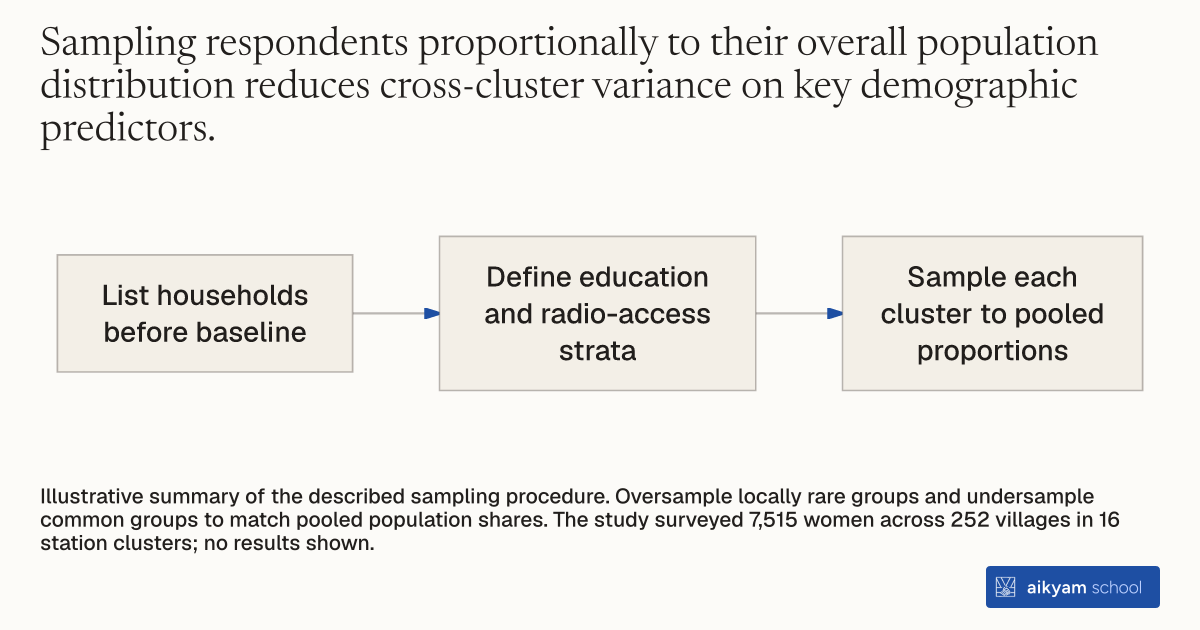
- List households before baseline
- Define education and radio-access strata
- Sample each cluster to pooled proportions
Illustrative summary of the described sampling procedure. Oversample locally rare groups and undersample common groups to match pooled population shares. The study surveyed 7,515 women across 252 villages in 16 station clusters; no results shown.
See source →How
When to use
In cluster randomized controlled trials with a small number of clusters, standard random sampling risks baseline imbalance and low statistical power. Evaluators want to make treatment and control clusters comparable across key individual characteristics like education and media access. Stratifying sample selection to mirror the overall population structure harmonizes clusters and improves statistical precision.
Harmonize study clusters by sampling respondents within demographic strata to match overall population proportions across all evaluation sites.
- Conduct a comprehensive household listing census across all selected study villages prior to baseline survey collection.
- Define demographic sampling strata based on critical baseline characteristics, such as formal education status and household radio access.
- Calculate target proportions for each demographic stratum across the entire pooled study population.
- Oversample underrepresented demographic groups in clusters where those characteristics are rare.
- Undersample overrepresented demographic groups in clusters where those characteristics are common.
- Survey sampled individuals within each cluster according to the harmonized stratum targets to produce balanced cluster profiles.
Why it works
This balance minimizes baseline noise and increases statistical power when evaluating interventions across a limited number of radio station clusters.
Example
In Burkina Faso, evaluators harmonized 16 radio station clusters by creating strata defined by education and radio access from a pre-baseline household listing. They oversampled educated women in low-education clusters and undersampled them in high-education clusters, resulting in balanced baseline characteristics across 7,515 surveyed women in 252 villages.
About the study
Participants
7,515 women across 252 rural villages in 16 radio station clusters in Burkina Faso.
Study Design
Stratified sample harmonization embedded in a pairwise cluster randomized evaluation.
Results
Stratified sample harmonization achieved balance across treatment and control clusters on age, marital status, education (18 to 20 percent), and baseline contraceptive prevalence (23 to 25 percent).