Try, learn and adjust
Check completion of the two-day business course
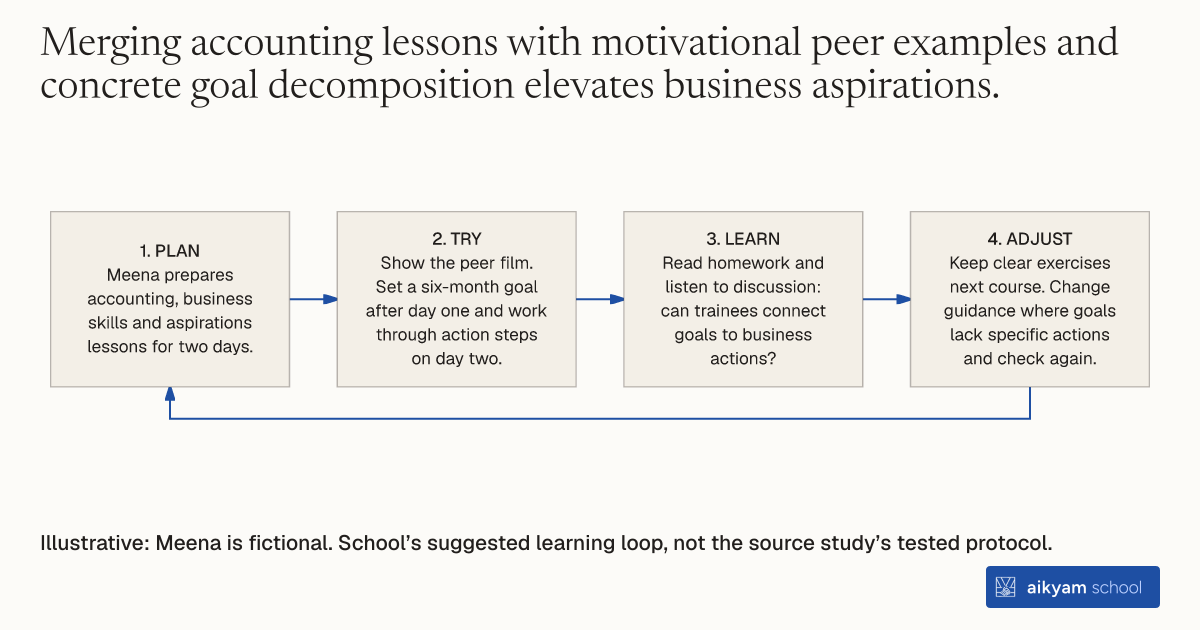
- Plan: Meena prepares accounting, business skills and aspirations lessons for two days.
- Try: Show the peer film. Set a six-month goal after day one and work through action steps on day two.
- Learn: Read homework and listen to discussion: can trainees connect goals to business actions?
- Adjust: Keep clear exercises next course. Change guidance where goals lack specific actions and check again.
Illustrative: Meena is fictional. School’s suggested learning loop, not the source study’s tested protocol.
See source →Observe homework and business discussions. School suggests this learning loop; it does not establish training effects.
How
When to use
Poor self-employed female microfinance clients often lack basic accounting skills and business management training. Longer multi-week training programs suffer from high dropout rates among working women with domestic responsibilities. A condensed two-day curriculum combines fundamental financial principles with practical business concepts to improve business management within tight schedules.
Deliver a condensed two-day training course that merges financial literacy, business skills, and aspirations modules for self-employed female microfinance clients.
- Combine core financial literacy topics like accounting and life-cycle planning with practical business skills like cost reduction and customer service into a two-day schedule.
- Screen an inspirational video featuring local microfinance members who successfully expanded businesses and escaped poverty.
- Assign participants a homework worksheet at the end of day one to define a six-month financial target.
- Guide participants on day two to break their six-month goal down into specific short-run action steps.
- Conduct interactive group discussions during training sessions to help participants apply business skills to their own enterprises.
Why it works
Condensed scheduling fits into the working routines of micro-entrepreneurs without overwhelming them with multi-week commitments.
Example
In Ahmedabad, India, researchers and SEWA Bank delivered a two-day training module to 289 female micro-entrepreneurs across 57 session clusters, increasing labor market activity by 19 percentage points among upper-caste Hindu women.
About the study
Participants
N = 597 female microfinance clients (346 Upper Caste, 70 Scheduled Caste, 181 Muslim) aged 18 to 50 in Ahmedabad, India.
Study Design
Randomized Controlled Trial evaluating 289 treated women across 57 two-day training sessions, measuring financial and business outcomes four months post-training using instrumental variables.
Results
Upper-caste Hindu women attending the training increased loan take-up by 13 percentage points (p < 0.05), increased business activity by 19 percentage points (p < 0.01), and increased business discussions with family by 17 percentage points (p < 0.05).