Try, learn and adjust
Check provider bonuses match job milestones
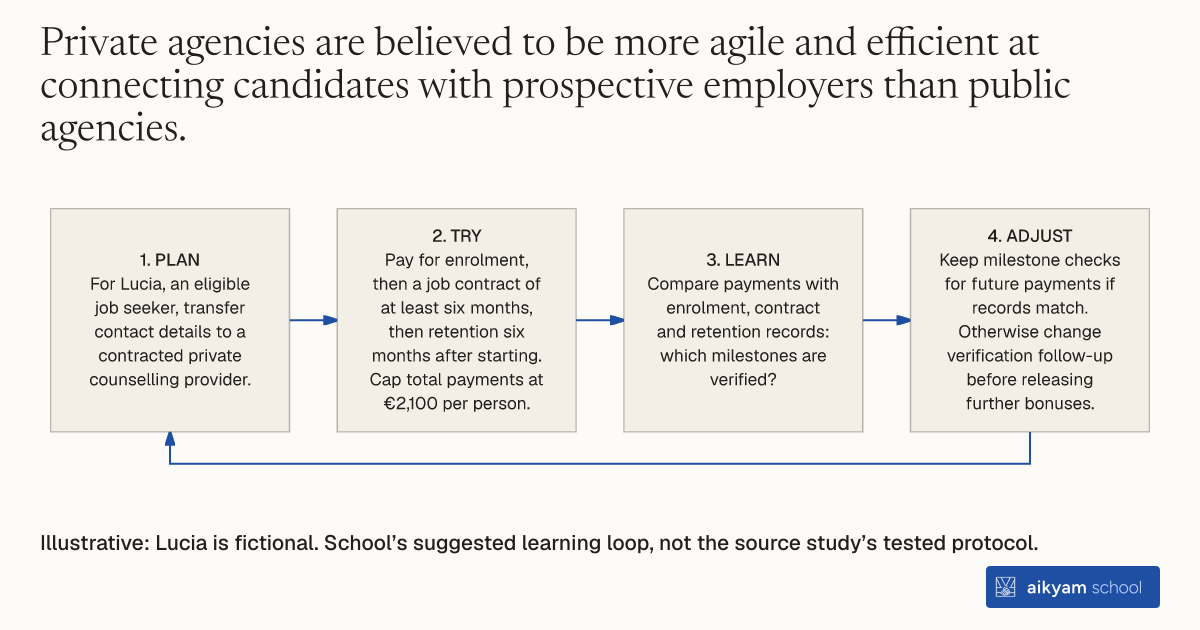
- Plan: For Lucia, an eligible job seeker, transfer contact details to a contracted private counselling provider.
- Try: Pay for enrolment, then a job contract of at least six months, then retention six months after starting. Cap total payments at €2,100 per person.
- Learn: Compare payments with enrolment, contract and retention records: which milestones are verified?
- Adjust: Keep milestone checks for future payments if records match. Otherwise change verification follow-up before releasing further bonuses.
Illustrative: Lucia is fictional. School’s suggested learning loop, not the source study’s tested protocol.
See source →School's suggested, untested loop: observe enrolment, contract length and six-month retention; initial placement advantages disappeared within twelve months in the study.
How
When to use
Public employment agencies often struggle to deliver intensive guidance to large numbers of unemployed graduates. Subcontracting placement services to private providers using financial incentives aims to leverage private sector efficiency. This method serves government labor departments seeking to accelerate job matching for young job seekers.
Subcontract job counseling to private providers using performance-based financial payments tied to candidate milestones.
- Partner with private for-profit and non-profit counseling firms to deliver specialized placement services.
- Transfer eligible job seeker contact information to contracted private agencies.
- Pay an agency fee when an eligible candidate enrolls in the counseling program.
- Disburse an outcome payment when a candidate secures a job contract lasting at least six months.
- Provide a retention bonus when the candidate remains employed six months after starting work, capping payments at €2,100 per person.
Why it works
Tying payments to employment benchmarks encourages counselors to focus on securing durable placements rather than providing passive advice.
Example
In 2007, the French Ministry of Labor subcontracted youth counseling services to private firms, offering incentive payments up to €2,100 per person across 235 communities. Across nearly 30,000 eligible job seekers offered counseling, only 35 percent enrolled in the private program, and initial placement advantages vanished within twelve months.
About the study
Participants
Nearly 30,000 young, college-educated job seekers in their mid-twenties across 235 communities in ten French regions.
Study Design
Randomized controlled trial comparing individuals assigned to contracted private counseling against comparison individuals using standard public services from Pôle Emploi.
Results
While offering private counseling increased short-term employment by 2.5 percentage points at eight months, take-up was only 35 percent and all relative gains disappeared by twelve months.