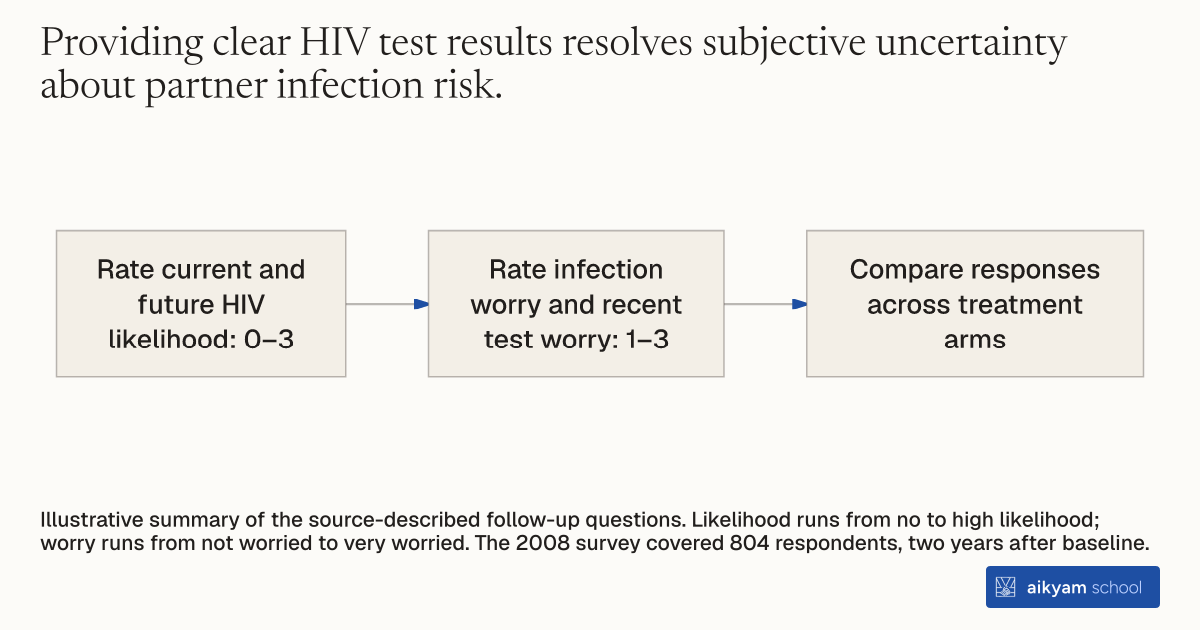
Research steps
Measure perceived HIV risk and worry
- Rate current and future HIV likelihood: 0–3
- Rate infection worry and recent test worry: 1–3
- Compare responses across treatment arms
Illustrative summary of the source-described follow-up questions. Likelihood runs from no to high likelihood; worry runs from not worried to very worried. The 2008 survey covered 804 respondents, two years after baseline.
See source →How
When to use
Evaluating health interventions requires measuring changes in participants' internal anxieties and perceived probabilities of infection. Standard clinical metrics do not capture individual psychological worry or perceived risk within marriage. Measuring subjective risk beliefs and worry quantifies how intervention information reshapes personal health expectations.
Measure participants' perceived HIV infection probabilities and emotional worry using standardized survey questions during post-intervention follow-up visits.
- Survey enumerators ask respondents to rate their current likelihood of being HIV-positive on a scale from 0 (no likelihood) to 3 (high likelihood).
- Enumerators ask respondents to rate their future likelihood of becoming HIV-positive on a scale from 0 to 3.
- Surveyors assess emotional worry by asking participants how worried they are about getting HIV on a scale from 1 (not worried) to 3 (very worried).
- Surveyors ask respondents how worried they were about their most recent HIV test on a scale from 1 to 3.
- Econometricians estimate linear OLS regressions comparing responses across treatment arms to measure reductions in perceived risk and anxiety.
Why it works
This directly reduces individual anxiety and fear of future transmission.
Example
Researchers surveyed 804 trial participants in rural Malawi two years post-baseline, finding that joint couples testing significantly reduced worry about getting HIV compared to individual testing.
About the study
Participants
804 respondents surveyed in 2008 from the baseline sample of 1095 married individuals in rural Malawi.
Study Design
Longitudinal follow-up survey using 4-point and 3-point ordinal scales and linear OLS regression models controlling for baseline demographic variables.
Results
Couples testing reduced reported current HIV likelihood by 0.160 points (p < 0.05), future likelihood by 0.142 points (p < 0.10), worry about getting HIV by 0.150 points (p < 0.05), and test anxiety by 0.070 points (p < 0.05).