Try, learn and adjust
Check appraisal-based raises follow stated criteria
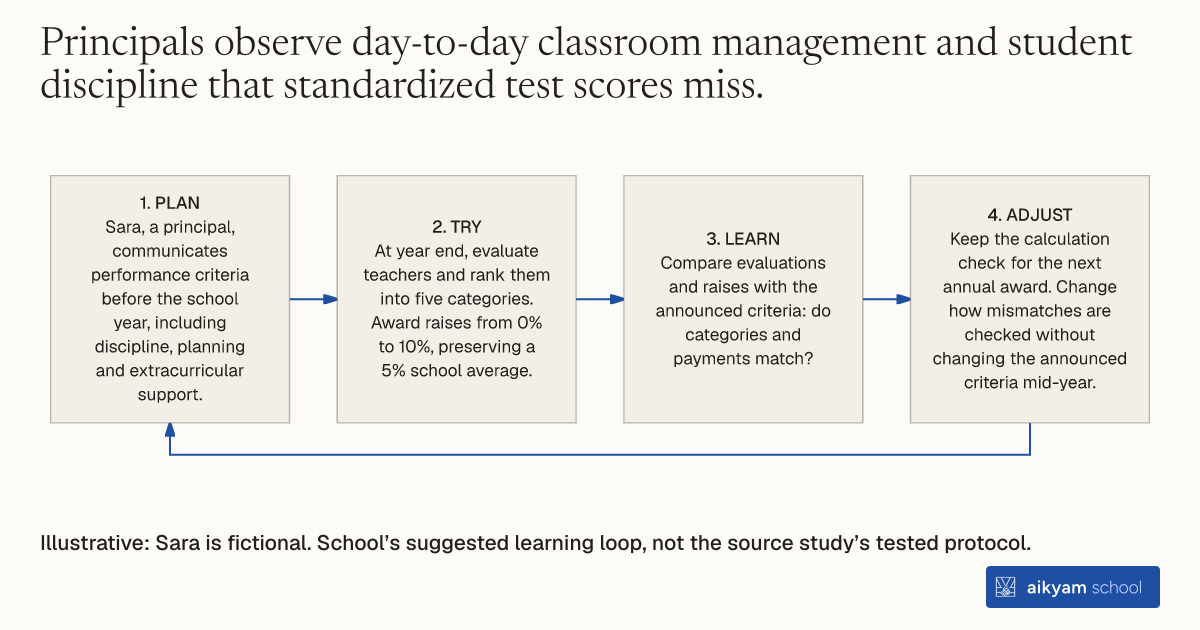
- Plan: Sara, a principal, communicates performance criteria before the school year, including discipline, planning and extracurricular support.
- Try: At year end, evaluate teachers and rank them into five categories. Award raises from 0% to 10%, preserving a 5% school average.
- Learn: Compare evaluations and raises with the announced criteria: do categories and payments match?
- Adjust: Keep the calculation check for the next annual award. Change how mismatches are checked without changing the announced criteria mid-year.
Illustrative: Sara is fictional. School’s suggested learning loop, not the source study’s tested protocol.
See source →School's suggested, untested loop: observe announced criteria, evaluations, categories and raises; no learning gain is assumed.
How
When to use
Schools often struggle to motivate teachers using fixed pay alone, but test-score-based incentives may fail to capture broader educational priorities. This method allows school leaders to align annual salary growth with holistic performance goals communicated directly by principals. It provides a flexible incentive structure for schools seeking to reward multi-dimensional teacher contributions.
Base annual teacher salary raises on end-of-year principal evaluations using a relative performance ranking within each school.
- Require principals to set and communicate explicit performance criteria to teachers before the start of the school year.
- Allow principals discretion to evaluate teachers across criteria such as student discipline, lesson planning, and extracurricular support.
- Conduct end-of-year subjective performance reviews for all eligible core subject teachers at the end of the calendar year.
- Rank teachers within each school into five relative performance categories based on their principal evaluation scores.
- Award annual salary raises ranging from 0 percent for the lowest-ranked category to 10 percent for the top-ranked category, preserving a 5 percent average raise per school.
Why it works
Linking raises to subjective appraisals motivates effort on broader, highly observable aspects of teaching while maintaining budget neutral average raises.
Example
A private school network in Pakistan implemented subjective performance raise tournaments across 139 schools for core teachers in grades 4 through 13. Principals communicated evaluation targets at the start of the year and assigned raises from 0 percent to 10 percent based on end-of-year ratings. Teachers assigned to this contract who preferred performance pay achieved student test score gains of 0.09 standard deviations.
About the study
Participants
139 schools with 3,566 teachers and over 40,000 students in grades 4 through 13 in Pakistan; teachers averaged 36 years of age, 5.7 years of experience, and 81 percent were female.
Study Design
School-level randomized controlled trial comparing a subjective principal evaluation performance raise tournament against a 5 percent flat raise control group over one school year.
Results
Principals rated highly observable outcomes like attendance and discipline accurately with coefficients of 0.19 and 0.23, but were less accurate on value-added at -0.05; for teachers who wanted performance pay, subjective performance pay increased test scores by 0.09 standard deviations.