Try, learn and adjust
Check stove construction and household contributions
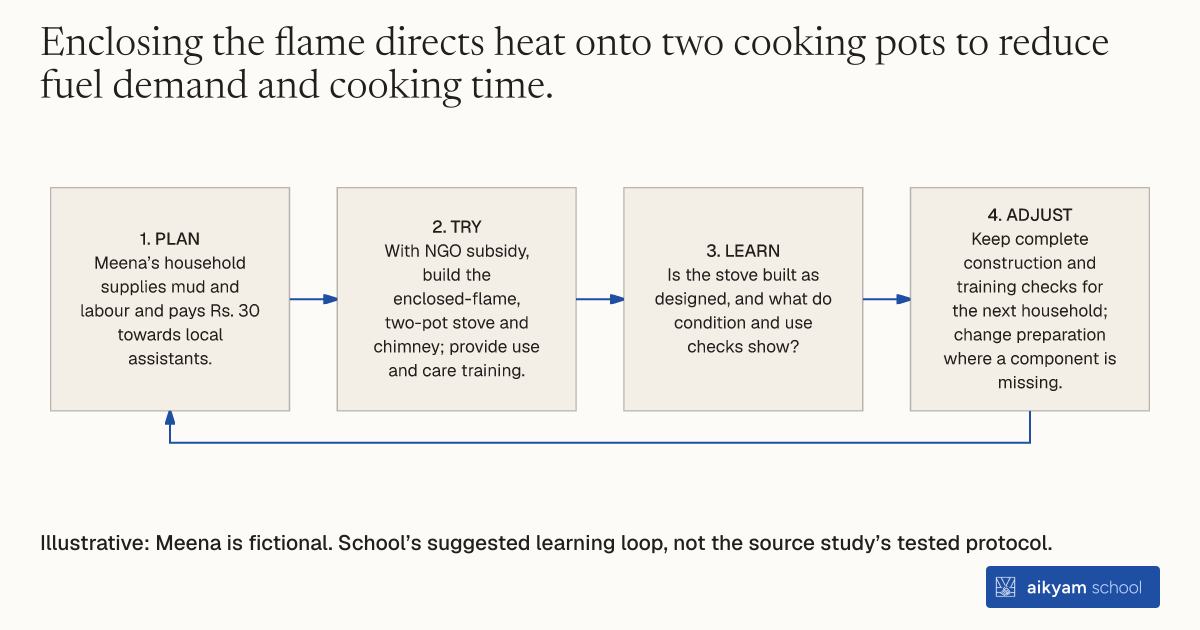
- Plan: Meena’s household supplies mud and labour and pays Rs. 30 towards local assistants.
- Try: With NGO subsidy, build the enclosed-flame, two-pot stove and chimney; provide use and care training.
- Learn: Is the stove built as designed, and what do condition and use checks show?
- Adjust: Keep complete construction and training checks for the next household; change preparation where a component is missing.
Illustrative: Meena is fictional. School’s suggested learning loop, not the source study’s tested protocol.
See source →School’s suggested learning loop, not a tested source procedure. Observe construction, contributions, condition and use; adoption alone does not establish health or fuel savings.
How
When to use
Rural households in developing countries burn solid biomass fuels in open traditional stoves, creating toxic indoor air pollution. Women and young children face heavy smoke inhalation and lengthy cooking times. Development organizations construct low-cost mud stoves with enclosed flames and chimneys to vent smoke and lower fuel requirements.
Construct ventilated two-pot mud cookstoves with enclosed flames and chimneys using subsidized funds and household co-payments.
- Local NGOs provide capital subsidies covering most of the total US$12.50 stove construction cost.
- Participating households supply mud for the stove base and provide construction labor.
- Households pay a co-payment of Rs. 30 (about US$0.75) to pay local assistants who help build and repair the stoves.
- Assistants build mud chula stoves with an enclosed flame, two pot seats, and an exhaust chimney.
- Instructors deliver household training sessions on proper stove operation and routine care.
Why it works
The exhaust chimney carries smoke outside the room to reduce indoor pollution.
Example
NGOs partnered with researchers in Orissa, India to construct subsidized mud stoves costing US$12.50 across 2,575 households in 44 rural villages. Households contributed mud, labor, and Rs. 30 (US$0.75) for builder fees. Initial adoption was high, making wave 1 households 62 percent more likely to have an improved stove in the first two years than comparison households.
About the study
Participants
2,575 households in 44 rural villages, Orissa, India.
Study Design
Four-year longitudinal Randomized Controlled Trial (RCT) measuring stove adoption, condition, and usage across staggered construction waves.
Results
Stoves cost approximately US$12.50 with a Rs. 30 (US$0.75) household payment. Wave 1 treatment households were 62 percent more likely to have an improved stove in years one and two, dropping to 44 percent in year three.