Try, learn and adjust
Check stove construction and household contributions
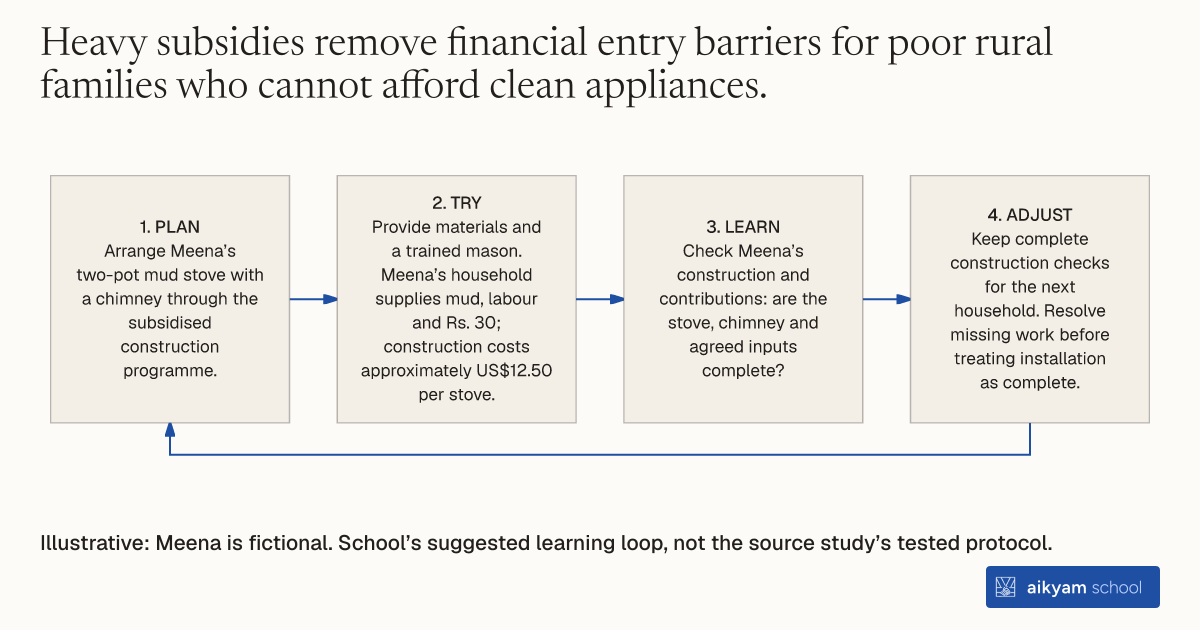
- Plan: Arrange Meena’s two-pot mud stove with a chimney through the subsidised construction programme.
- Try: Provide materials and a trained mason. Meena’s household supplies mud, labour and Rs. 30; construction costs approximately US$12.50 per stove.
- Learn: Check Meena’s construction and contributions: are the stove, chimney and agreed inputs complete?
- Adjust: Keep complete construction checks for the next household. Resolve missing work before treating installation as complete.
Illustrative: Meena is fictional. School’s suggested learning loop, not the source study’s tested protocol.
See source →School’s suggested, untested loop. Observe construction and household contributions; ownership does not establish lasting use or health benefits.
How
When to use
Many rural households rely on polluting traditional biomass fuels for daily cooking energy. High upfront costs prevent poor families from purchasing clean technologies on their own. Non-governmental organizations can offer heavy subsidies paired with small household co-payments to encourage adoption.
Subsidize mud chulha cookstove construction by pairing external project materials with local household co-payments.
- Provide core construction materials and pay for a trained mason to build two-pot mud stoves with chimneys, as Gram Vikas did in Orissa.
- Require participating households to provide base mud, manual labor, and a cash co-payment of Rs. 30 (about US$0.75) for the mason.
- Cap total construction expenditure at approximately $12.50 per stove using grant or donor funding.
- Train local masons to build enclosed flame designs that vent smoke outdoors through chimneys.
Why it works
Small co-payments ensure households make an active financial commitment toward installing the stove in their homes.
Example
Gram Vikas obtained grant funding to subsidize 15,000 improved mud stoves costing $12.50 each across rural Orissa, requiring households to contribute mud, labor, and Rs. 30 for the mason.
About the study
Participants
2,651 participating households across 44 villages in Orissa, India.
Study Design
Randomized controlled trial (RCT) with households assigned via public lotteries to receive stoves across three phased waves.
Results
Treatment households were 65 percentage points more likely to own an improved stove than comparison households during the first two years, but ownership fell to a 44 percentage point difference by year three due to disrepair.