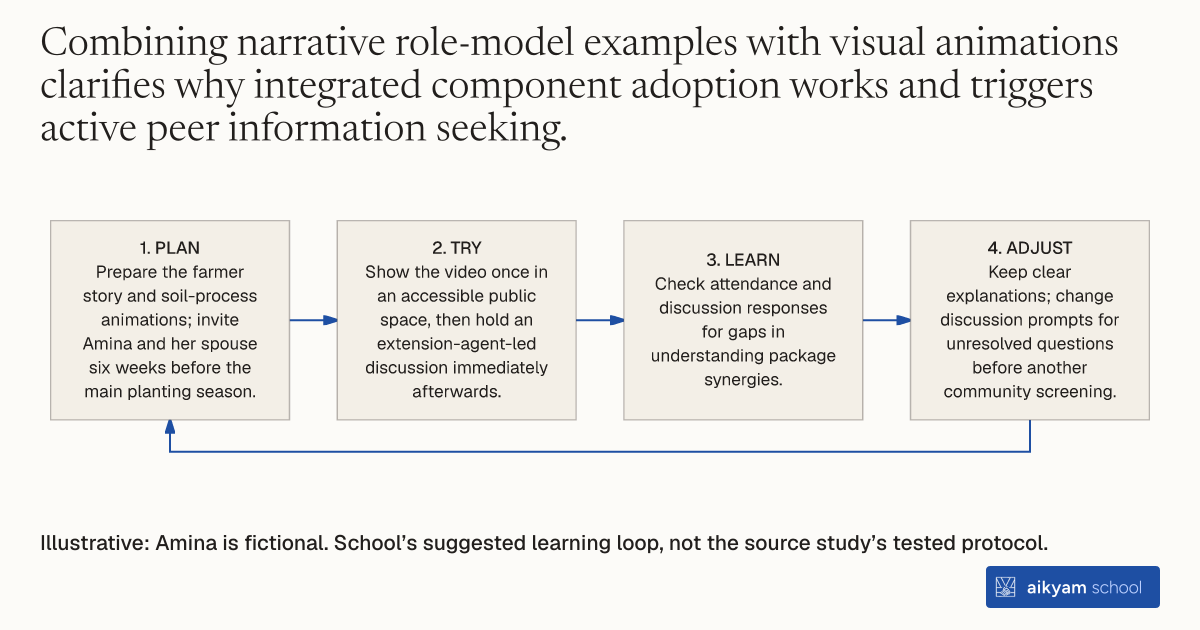
Try, learn and adjust
Check screening and discussion before planting
- Plan: Prepare the farmer story and soil-process animations; invite Amina and her spouse six weeks before the main planting season.
- Try: Show the video once in an accessible public space, then hold an extension-agent-led discussion immediately afterwards.
- Learn: Check attendance and discussion responses for gaps in understanding package synergies.
- Adjust: Keep clear explanations; change discussion prompts for unresolved questions before another community screening.
Illustrative: Amina is fictional. School’s suggested learning loop, not the source study’s tested protocol.
See source →Observe invitations, attendance and understanding; this loop does not require repeat viewing by the same household. School suggests this learning loop; it was not tested by the source.
How
When to use
Decentralized extension systems often suffer from degraded peer information diffusion when conveying complex agricultural packages. Indirect community beneficiaries miss critical functional rules and synergy benefits. Screening targeted educational media directly addresses knowledge gaps and reinforces peer-to-peer technology adoption.
Expose rural community members to educational media screenings and extension-guided discussions before the growing season begins.
- Produce a tailored movie combining a local farmer role-model narrative with technical animations of biological soil processes.
- Issue oral and written invitation cards to local household heads and spouses six weeks before the main planting season.
- Host public screening events in accessible village locations such as farmer training centers, health posts, or local schools.
- Screen the video once using portable projection equipment to convey core package synergy concepts.
- Lead a structured group discussion immediately following the video screening, facilitated by local public extension agents.
Why it works
Group screening events also create shared local gathering spaces for direct peer discussions.
Example
Project staff screened localized video versions across 36 microwatersheds in Tigray, Amhara, and Oromia in Ethiopia in early 2017, achieving 94% household attendance (499 households). Among non-group peer farmers, adding video screenings increased full-package integrated adoption by 8.4 percentage points and raised overall principles knowledge by 4.2 percentage points over control groups.
About the study
Participants
N = 542 households (804 individual participants) across 36 treatment microwatersheds in Ethiopia.
Study Design
Cluster Randomized Controlled Trial comparing extension plus video against extension alone and control groups.
Results
Video screenings increased non-member peer principles knowledge by 4.2 percentage points (p < 0.01) and integrated full-package adoption by 8.4 percentage points (p < 0.01) relative to matched controls.