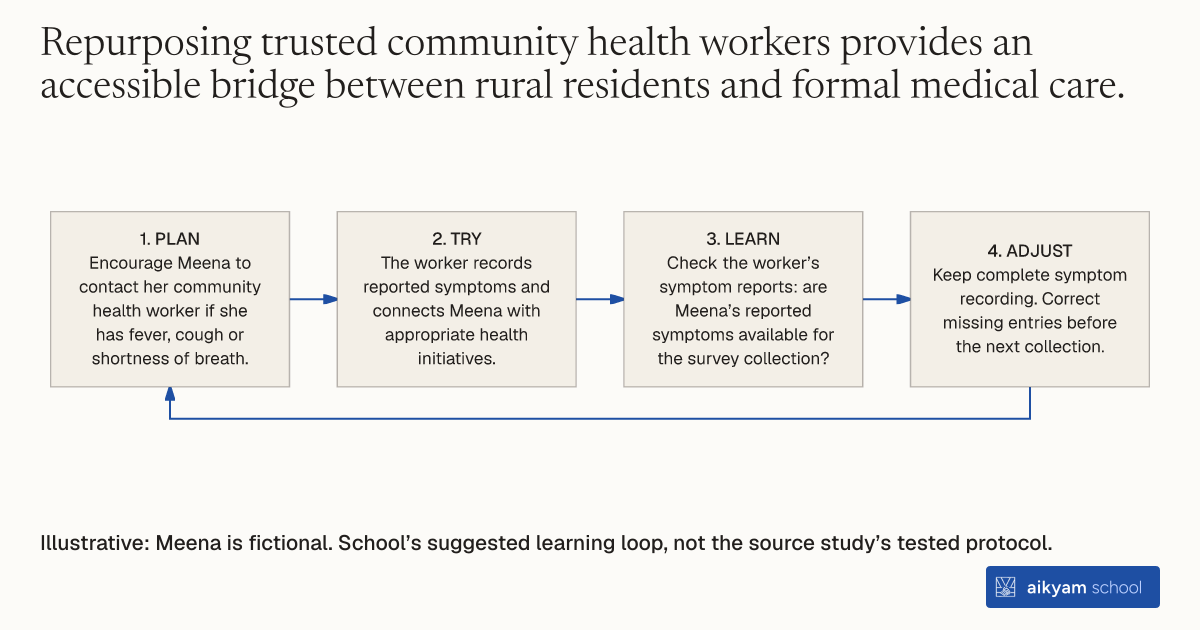
Try, learn and adjust
Check symptom reports reach local health workers
- Plan: Encourage Meena to contact her community health worker if she has fever, cough or shortness of breath.
- Try: The worker records reported symptoms and connects Meena with appropriate health initiatives.
- Learn: Check the worker’s symptom reports: are Meena’s reported symptoms available for the survey collection?
- Adjust: Keep complete symptom recording. Correct missing entries before the next collection.
Illustrative: Meena is fictional. School’s suggested learning loop, not the source study’s tested protocol.
See source →School’s suggested, untested loop. Observe citizen-reported symptoms and collected reports; more reports do not establish more infections.
How
When to use
During health emergencies, rural populations often lack direct connection to formal healthcare systems. Public health authorities need decentralised channels to monitor disease outbreaks without overloading hospitals. This method enables health authorities to encourage citizens to report fevers and respiratory symptoms directly to local community health workers.
Encourage citizens exhibiting disease symptoms to report their health status directly to local community health workers.
- State health departments repurpose existing community health workers to link rural populations to healthcare systems.
- Authorities distribute public health messages encouraging citizens to consult local community health workers when exhibiting symptoms.
- Citizens contact local community health workers to report fever, cough, or shortness of breath upon experiencing symptoms.
- Community health workers record incoming citizen health reports and direct individuals to appropriate medical initiatives.
- Surveyors contact frontline community health workers to aggregate reported symptom data across postal index areas.
Why it works
Local workers remove travel barriers and give residents a familiar point of contact during health crises.
Example
During the COVID-19 pandemic in West Bengal, India, the state government encouraged rural residents to report health symptoms to local community health workers. Following a video messaging outreach, recipients reported 23 more fever cases and 18 more coughing cases to community health workers within five days compared to comparison communities.
About the study
Participants
759 frontline community health workers across rural and urban postal index areas serving 28 million phone network subscribers in West Bengal, India.
Study Design
A randomized controlled trial measuring citizen symptom reports recorded by community health workers across 1,264 postal index areas receiving either celebrity video messaging or standard government links.
Results
Within five days of message delivery, citizens reported 23 more cases of fever (an 81.4 percent increase) and 18 more cases of coughing (a 90.2 percent increase) to community health workers relative to the comparison group, with elevated fever reporting continuing three months later.